

Two farming families, one going back generations, the other brand new. Together, their stories speak to hometown agriculture heritage, the future of our food, and, as Creston Valley writer Danette Polzin discovers, the embrace of a most profound calling.

Calloused hands built the land — The Creston Valley agriculture industry generates roughly $27.5M annually, an output achieved using about half of the region’s available agricultural land. — Ashley Voykin Photo
The Creston Valley is as rich in memories for me as it is steeped in history. My childhood was full of barefoot running in the dirt, juices on my face from whatever fruit happened to be in season. My grandparents owned property on the Goat River bottom, and my grandfather had a penchant for growing potatoes. When we weren't in the fields, we were seeking shade under fruit trees, a fresh plum or apricot always within arm's reach.
Only when I moved to Alberta and paid $10 a pound for Okanagan cherries did I realize our privilege — much of the world doesn't understand what we reap here. When I returned to Creston in late 2018, the prominence of fruit stands lining the highways brought my heart delight — neighbours and strangers constantly offloading fresh-grown produce. The age-old joke that you must roll up your windows during zucchini season still rings true.
As I've grown older and looked around at all the challenges we face collectively, one thing has become clear: our food system is much more important than many of us realize. Food provides health, nourishment, livelihoods, and community. And it seems much of that is quickly slipping away — especially outside this idyllic valley.
By the Numbers
According to Agriculture and Agri-Food Canada, B.C. contributed 30.6 per cent of Canada's total tree fruit production in 2021, yet overall fruit production declined 5.3 per cent from the previous year.
Within B.C., the Okanagan dominates with 80.2 per cent of the province’s tree fruit acreage. The Creston Valley holds just 2.9 per cent — small in scale but distinct in character, with production heavily oriented toward cherries. With over 1,100 farms across the full spectrum of agriculture, the valley is positioned as the region's primary agricultural centre.
Yet modern farmers face myriad challenges. Climate volatility, labour shortages, rising costs, and succession planning pressure growers. Jennifer Woike, president of the B.C. Agriculture Council, doesn't mince words: "B.C. is the most expensive province to farm in Canada." Fertilizer prices jumped more than 80 per cent in 2022 alone. For cherry producers, trade tensions have flooded Canadian markets with American fruit, driving producer's returns to below $0.80 per pound while production costs average $1.60 per pound. Meanwhile, climate change intensifies these pressures through hotter summers, declining rainfall, and shifting growing conditions.
Roots in the Floodplain
Before European settlement, the Yaqan Nuʔkiy people relied on the valley's rivers and wetlands for fish, game, and wild plants, their stewardship maintaining rich soils for generations. The story of modern agriculture here begins with water, and the struggle to control it. Early dike-building efforts failed until the Goat River Dam was opened in 1933, making the flats reliably arable.
By the early 1900s, apple orchards dotted the landscape, and a landmark 1908 property sale sparked what observers called the "Creston Valley fruit boom." As “Strawberry Capital of the World,” Wynndel shipped almost 20,000 strawberry crates annually at its peak in the '30s. Then came Little Cherry Disease in 1933, decimating orchards and reshaping the valley's identity for decades.
When reliable disease control finally emerged in the 1990s, cherry prices were rising while cheap American apples flooded the market. Government replanting incentives catalyzed the modern identity. Today, roughly 92 per cent of the region's 388 acres of tree fruit production is cherry orchards.
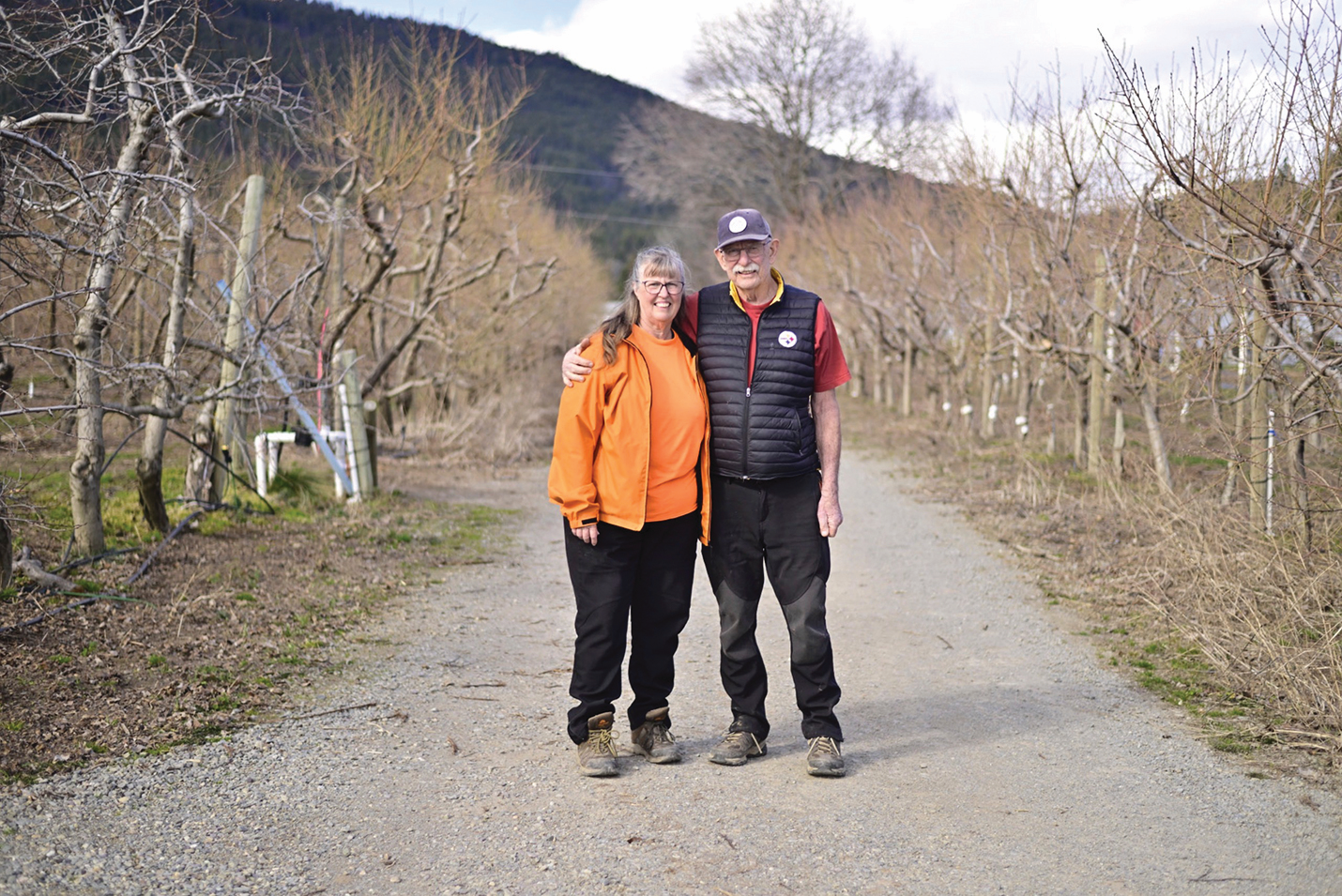
Long haul — Frank and Barb Wloka have spent over 40 years farming in Erickson, riding out the highs and lows of their land — including a standout cherry season that yielded nearly 500,000 pounds of crop. — Steve Ogle Photo
Rooted in the Orchard
Frank Wloka was raised in an orchard, and almost born in the orchard. The Creston Valley Hospital, technically, but his mother probably would have delivered him among the trees if she could have.
His parents moved to Creston in the 1950s, his father working in a cherry orchard. They saved until they could buy a tiny place on Erickson Road for $500 — a fortune in those days. The house had three rooms, no indoor bathroom, and a cook stove in the basement. The furniture was apple boxes and planks.
Frank’s childhood was shaped by dirt and shifting seasons. His parents grew strawberries, and young Frank's job was hauling carriers — four carriers in his hands with six baskets on each carrier — out of the fields.
"My arms are so long because of it," he jokes.
In his teens, Frank rejected farming. After working at Overwaitea Foods and then a stint in Squamish, he eventually bought his own place in Creston, where he met Barb — a waitress at the local donut shop.
She'd grown up in the valley after her father, a school superintendent, moved the family here. She'd travelled to Brazil, Australia, and New Zealand before returning to work at the donut shop, where Frank's flirting turned into partnership. Barb ran Frank's first fruit stand for years before he married her.
"The family joke is he wanted to make sure I could do something," she says. "I knew nothing about farming. Nothing."
That first stand opened in 1980: a dirt-floored shed attached to a two-bay garage. No bathroom. Barb changed their daughter Keandra's diapers while selling fruit. When Alex Nielsen, then the local health inspector, stopped by during one particularly memorable incident involving a baby, a mess, and a garden hose, he simply asked: "So, you're putting a bathroom in next year, aren't you?"
They did.
For 16 years they ran the stand while Frank also worked at Columbia Brewery. A Labatt opportunity took them to the U.S. and Russia for a decade, managing half a million pounds of cherries annually from 11 time zones away.
"Frank knew his trees so well he could do crop estimates from photographs better than the crew on the ground," Barb says.
But wholesale farming eventually broke them.
A shipment destined for Germany sat unrefrigerated on a Paris tarmac for 24 hours, the loss returned to them. "That's when we thought, this is stupid," Barb says.
They returned to Creston in 2006 and opened their current operation in 2014. Today, Wloka Farms spans 80 acres: 40 in market garden, 40 in orchard. They grow 55 varieties of squash alone, along with tomatoes, peppers, corn, cabbage, apples, cherries, and much more. In 2025, they employed 58 people: front staff, back staff, and field crew, including 10 workers from Mexico and one from Guatemala who have become essential to the successful operation.
"If we didn't bring in those 11 migrants, the other 47 wouldn't have a job," Frank says. "This place wouldn't be here."
The work is relentless. Climate volatility means constant adaptation. 2024 brought near-total crop loss for stone fruits from early freeze; 2025 delivered abundance. They've learned to save in good years and to diversify against disaster.
"Every year's a good year," Barb says. "Some years are just better than others."
Through it all, they've never stopped learning. Frank continues discovering storage incompatibilities; a $50,000 bean picker proved unnecessary; a strawberry experiment ended in herbicide disaster.
"You're going to make mistakes," Barb says. "You have to learn to laugh at them, because if you don't, you’ll never survive."
What keeps them going isn't money — Frank hasn't drawn a wage since retiring from the brewery.
"Many years ago, a customer said to me, 'What an honour to put food on people's plates,'" Barb recalls, her voice catching. "When things get hard — weather's wrong, bugs are horrible, you're losing sleep — I come back to that. People take my carrots, my potatoes, and my apples home, sit down at their table and eat dinner with my food on their plate. They talk about their day, take that good food into their bodies and go on living their lives. There's nothing you can do that's more important than feeding people."
Frank and Barb are looking for a succession — someone to carry this forward with the same love they've poured into it. But after nearly half a century of farming through flood and freeze, disease and drought, Frank and Barb Wloka have learned one thing above all: you keep going.
"We farm to farm," Barb says simply. "And we always will."
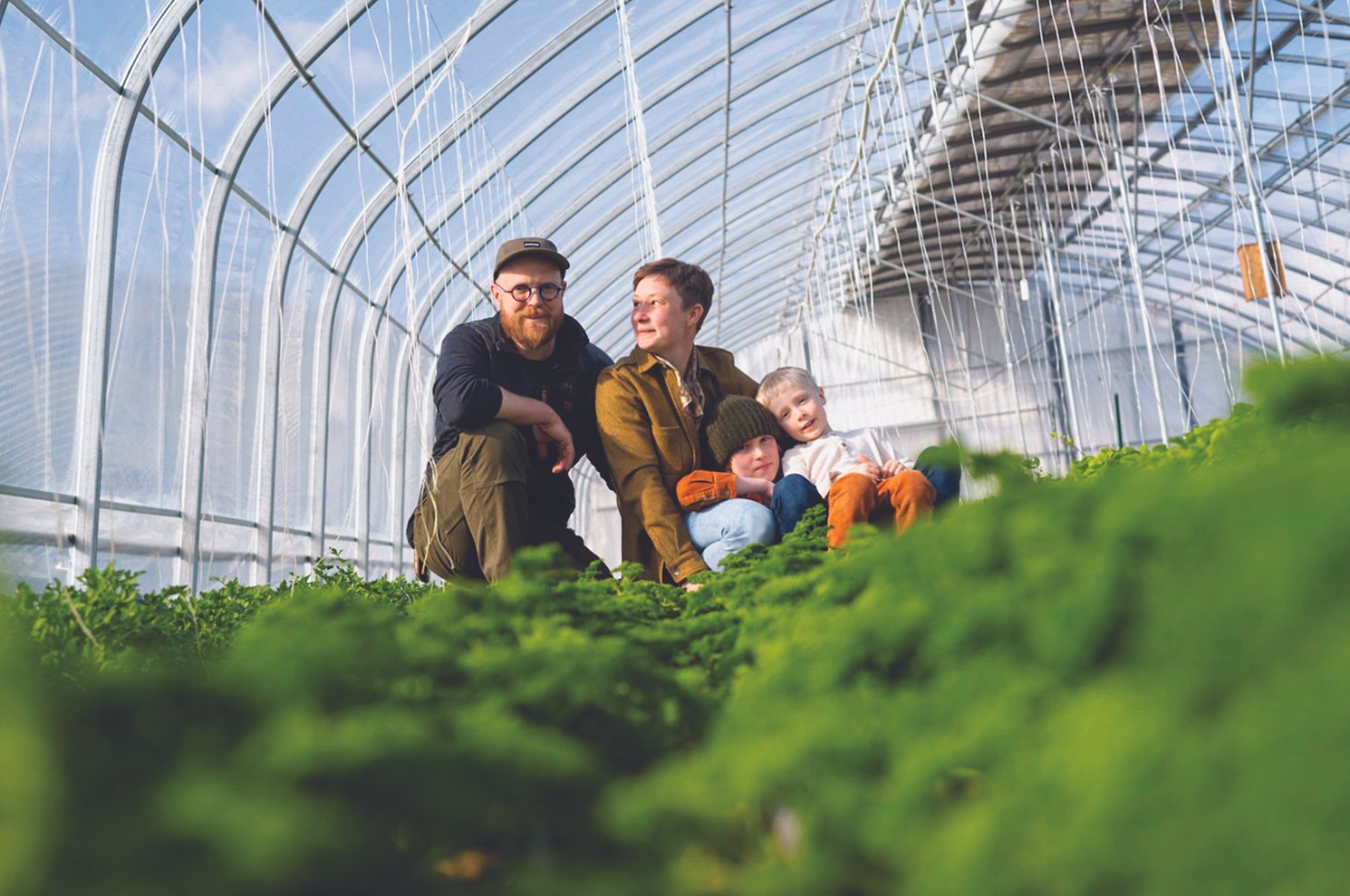
Seal of soil — Cartwheel Farms founders Nigel and Laura Francis and their boys. Cartwheel is among approximately 7,500 certified organic farms in Canada, which represents about 3.3 per cent of the country’s farming operations. Certification requires detailed record keeping and regular inspections. — Steve Ogle Photo
Finding Home in the Soil
Nigel and Laura Francis didn't set out to become farmers. They weren't even sure they'd stay in the Kootenays.
The couple met in 2003 at an international boarding school on Vancouver Island, then wound their way through universities in Vancouver and Toronto. By Nigel's master's degree at University of Toronto, both were struggling with urban life's grind.
"It didn't work for us," Laura says simply.
Nigel's family expected him to follow his father and sister into law. He applied, and was accepted, to UVic's environmental law program, with dreams of taking down Monsanto — and the couple prepared for their next whirlwind. But first, they needed to breathe. They remembered a place they'd driven through one summer while hiking across B.C. — a charming little valley that had stuck with them.
They rented the first place that came up and landed in Boswell in 2009.
"We were hanging out with people in their sixties and seventies," Nigel recalls. "They had better life experience and advice to give us."
One evening, one of those retirees said something that changed everything: “This doesn't really sound like your story. If you want to not do that, you could live with us.”
Nigel deferred his law school admission. They stayed.
For three and a half years, they house-sat around Boswell, surrendering to community needs.
In their last stretch of house-sitting, the couple took Michael Pollan’s online Rise and Future of the Food Movement course at UC Berkeley. The final lecture was by Carlo Petrini, founder of the Slow Food movement, speaking about food as culture, as community building, as something central to life itself.
In the Q&A, someone asked what a young person should do to contribute to the food system.
"Be a farmer," Petrini said, laughing in his Italian accent.
"It was super provocative," Nigel says. "We'd been theorizing about food and ethics and farming practices, but not actually in it. And I thought, 'Well, someone's got to do it.'"
They bought their farm in December 2014. The land was already certified organic, requiring no transition period. They started Cartwheel Farms from scratch, knowing almost nothing, learning as they went.
"There's nothing that prepared us for doing this," Laura admits. "Our families weren't going to feel super cool about it. We had no money. There was a lot of surrender."
Today, they grow over 150 varieties of vegetables and herbs across their operation, selling on-site and at the farmers' market, and feeding roughly 200 families through their weekly delivery service. What sustains that relationship with their customers is the way they choose to farm.
Their commitment to sustainable farming runs deeper than organic certification. They've installed solar panels to power an electric delivery van. They compost local waste to feed soil rather than trucking in fertilizer. Their greenhouses feature thermal blankets that reduce heating needs and provide shade during heat waves.
"It's about ethical and ecological integrity," Laura explains. "Everything from how we source our seed, to what we apply to the field, to how we move food. It should be a given that our food doesn't have adverse human or ecological health impacts."
The Francises also created the Cartwheel Farm Sharing Fund, where customer contributions help provide deliveries to families in need. Laura also stocks a "friendship fridge" at the Lower Kootenay Band with food for anyone who needs it.
The challenges the Francises face are less about regulation or labour — though those exist — and more about culture. People's disconnection from food and loss of cooking skills shrinks the pool of customers who can transform raw produce into meals.
"We're selling ingredients," Nigel says. "If customers aren't able to make them into something, we don't have a product anyone wants to buy."
"There's hope signalled by putting time into feeding ourselves well," Laura reflects. "And if people aren't feeling invested in that — time, skills, whatever — that's hard."
But there's also profound reward in their work. They've witnessed health transformations, family reconnection, and customers gaining courage to quit jobs, start gardens, and rethink food entirely.
Listening to stories like these, I'm reminded how easily those connections can be taken for granted when you grow up surrounded by farms and fruit stands.
"Food is a gateway to what's best in ourselves. An easy one, too. And we live in a bit of a fairytale here," Laura admits. "We can feel as excited as we do about feeding people because people are excited to be fed. This is an agricultural community. People care."
The Roots We Share
Two farms. Two stories. One truth. Frank and Barb Wloka hold deep roots in the valley with generations of learning the land's rhythms and garnering the hard-won knowledge that comes from weathering countless seasons of trial and triumph. Nigel and Laura Francis bring the vibrant energy of first-generation farmers who stumbled into the Kootenays almost by accident and discovered their calling in the soil.
Yet sit with either couple long enough and the same message emerges: food, community, and connection matter. Food is more than a commodity; we are more than consumers. It is an essential part of both our inner and outer ecology, nourishing us on levels most of us don't even think about.
And this shared conviction — that growing food is an act of love, community building, and cultural preservation — runs deeper than any debate about organic versus conventional, wholesale versus direct-to-consumer, traditional versus innovative. It's the thread that connects the Wlokas' 58-person operation with Cartwheel Farms' intimate weekly deliveries. It's what makes the Creston Valley more than just another agricultural region.
Beyond that, in terms of Canada’s organic market, it’s booming — now over $9 billion annually. But domestic production hasn’t kept pace, driving up imports and missed opportunities for domestic farmers. A 2025 Canadian Organic Growers report calls for $68.5 million annually to triple organic agriculture, recognizing both private gains from price premiums and public benefits like climate resilience and biodiversity. Regenerative agriculture — emphasizing no-till methods, ground cover, and integrated livestock — is also rising to improve soil health and capture carbon.
The Creston Valley is well-positioned in this landscape, growing diverse crops and livestock for both local and export markets. High transport costs encourage local production and value-added processing — turning raw farm products into processed goods that farmers can sell themselves. Organizations like Fields Forward and the Kootenay Farms Food Hub are working to strengthen these connections: they provide commissary kitchens, processing equipment, and support that keeps food dollars local. Their work represents the kind of infrastructure investment that regional food security requires.
But the challenges are real. The B.C. agriculture industry faces persistent losses. Sixty per cent of Canadian farm operators are over 55, while fewer than nine per cent are under 35. Labour shortages leave 10 to 30 per cent of B.C. fruit crops unharvested. Climate volatility creates new risks for aging production systems.
The Wlokas watch for successors who might carry their operation forward with love. The Francises pour themselves into feeding families while wondering how sustainable their pace can be. Across the valley, aging farmers face the same question: who comes next?
Time will tell, but the stats show that a demand for local food grown with care rewards producers who focus on quality, sustainability, and genuine connections with their customers. Farmers' markets, CSAs, and farmgate sales reflect a deeper desire to know our food and its growers.
Perhaps this valley, with its rich soils and richer traditions, its weathered orchardists and idealistic newcomers, its fruit stands and food hubs and weekly delivery boxes, represents something worth protecting. A model for what food and farming could mean across North America well into the future.
The future of agriculture in communities like Creston will depend on many things: public investment, infrastructure, water stewardship, and climate adaptation. But fundamentally, it will require valuing regional food production as a public good worth sustaining, not merely as a commodity to be optimized through industrial consolidation.
It will require us to remember what the Wlokas and Francises already know: that food is more than fuel, that farming is more than business, that the act of feeding one another is among the most human and meaningful things we do.
When I think back to those childhood days running barefoot and carefree, I realize now what I couldn’t see then: that abundance wasn’t ordinary at all. It was the result of generations of people who chose to care for this land and feed their community. And if this valley continues to thrive, it will be because people like them — and perhaps the rest of us too — decide that this work is worth carrying forward.
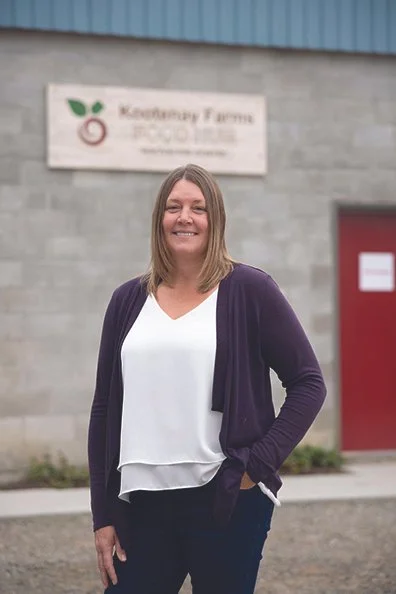
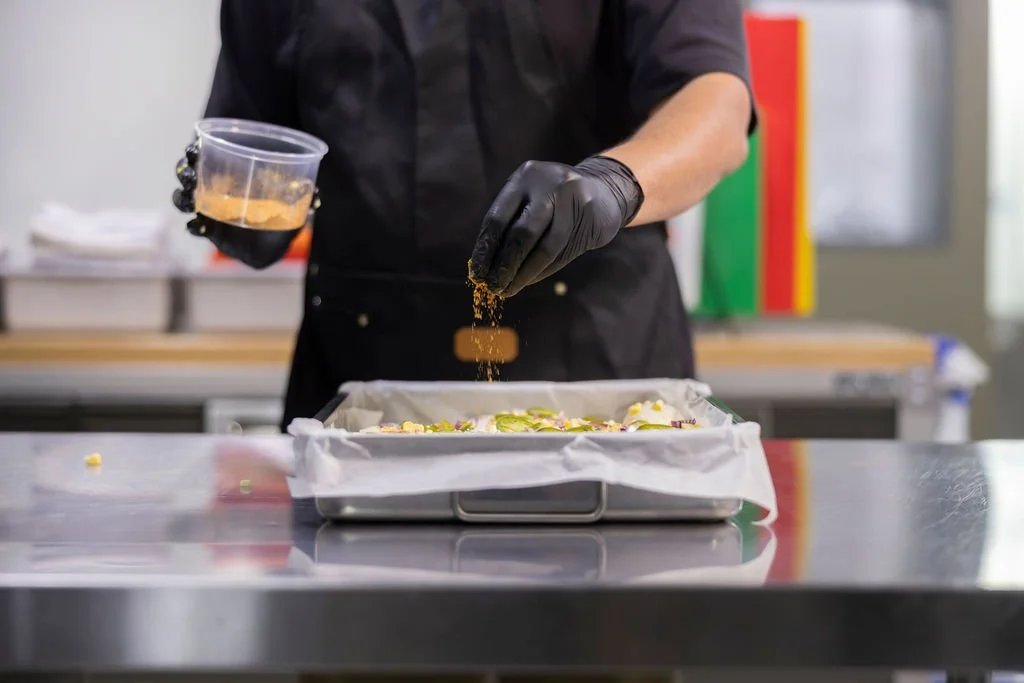
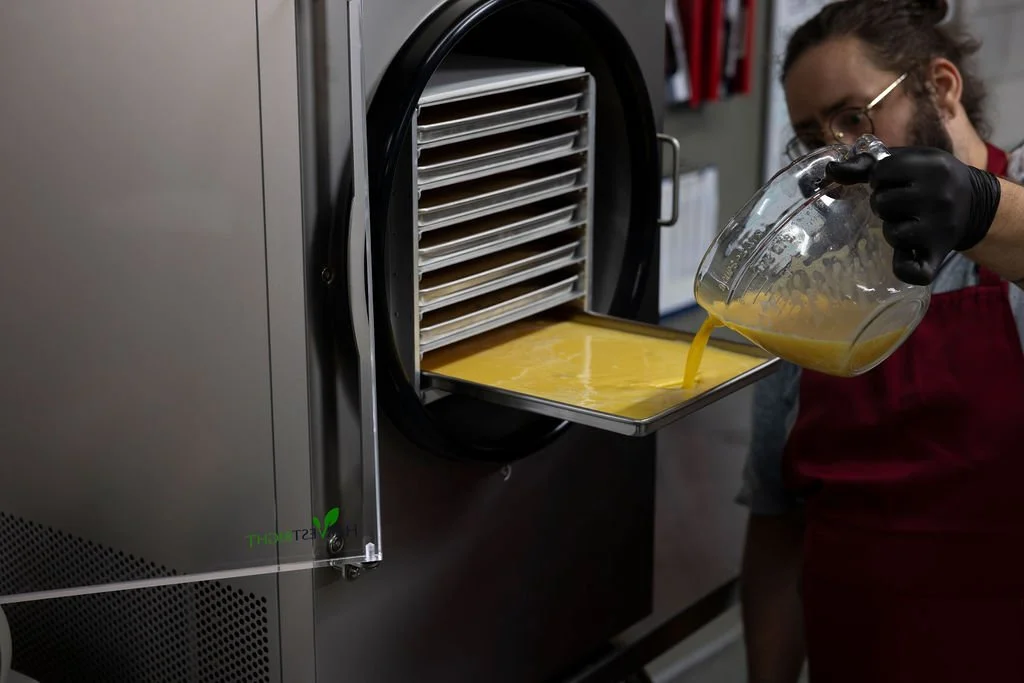
Food, with thought — With storage options, processing facilities, and fully-equipped commercial kitchens to create value-added products — all available to food producers of any size at accessible rates — the Kootenay Farms Food Hub was established to help businesses grow sustainably and create long-term success. — Picnic Creative Photos
Building the Infrastructure for Local Food
When Fields Forward was established 15 years ago, growers posed a simple question: what do you need? The answer shaped everything.
"Our ultimate job is really to support the farming community and the agricultural community to move with changing times," says Tanya Wall, who leads the organization. "But also to keep them as secure and safe as possible — so that we don't lose another farmer."
Tanya Wall combines entrepreneurial experience with public service, having spent about 14 years in local government as RDCK Area B director before becoming the executive director of Fields Forward and the Kootenay Farms Food Hub.
Fields Forward advocates for farmers, connecting them with policymakers and supporting education. But its most visible achievement sits at 401 Payne Street in Creston: the Kootenay Farms Food Hub Innovation Centre, one of 13 food hubs established by the provincial government, and the only one serving the East and West Kootenays.
The philosophy of the Food Hub is straightforward. Fields Forward invests in equipment and infrastructure, then offers it to producers and farmers' market vendors at affordable fee-for-service rates. This lets entrepreneurs test ideas and build businesses without major capital investment.
"It gives producers the opportunity to try new things in value-added products," Wall explains. "Which then diversifies their businesses from just growing fruits and vegetables and having to sell them in that seasonal space."
The hub operates three main spaces. The commissary kitchen — the most active component — includes a shared prep space and an isolated kitchen where up to four producers can work simultaneously. Secondly, processing houses freeze dryers, pouch-filling equipment, and cold storage. And finally, a CFIA-regulated space allows Old Iron Ranch to wash, inspect, grade, and ship eggs to Kootenay Co-op in Nelson, connecting Central Kootenay producers with West Kootenay markets.
The model has already spawned independent businesses. Fields Forward's mobile juicing operation evolved into two profitable enterprises: Faraman Farms and Pippin Point, the latter now experimenting with ciders and ginger tonics, along with juices. Twenty-one different producers currently rely on these two businesses for value-added processing.
"Through the support of Fields Forward and the Food Hub being there, we now have business entities that are developed and supporting other producers," Wall says. "Which then in turn gives us more space to explore other options."
The collaboration extends beyond commercial production. Fields Forward now works alongside the Creston Valley Food Action Coalition — which operates the Creston Valley Farmers’ Market and the Harvest Share Program — and collaborates with the Creston Valley Gleaners' Food Bank. The three organizations have streamlined their efforts: harvested produce comes to the hub for sorting, with the best going to the food bank while "not so perfect" items get processed into jams, soups, or freeze-dried products that return to school lunch programs and community organizations.
The numbers reflect the impact. Between the farmers' market and Food Hub, the organizations facilitated approximately $1.7 million in economic activity in 2024. Grant funding brought in $900,000 for community programming, with projections of $1 million for 2026.
A federal Local Food Infrastructure Fund grant will soon add a hydroponic growing module capable of producing 600 heads of lettuce weekly, with production split between food banks, school programs, and revenue-generating retail sales. A community garden will provide tools, education, and garden space for apartment dwellers and seniors.
But Wall is clear-eyed about the challenges facing the sector. Generational farming has declined. Labour shortages have pushed many operations toward foreign worker programs. Water availability and heat dome cycles threaten production. And the cost of inputs continues rising while retail prices remain stubbornly flat.
"A farmer isn't growing produce to get rich," Wall says. "They're doing it because they're passionate about feeding people. But in the end, they still need to make money — or at least break even — so they can continue to farm."
She points to consumer expectations as another barrier. Commercialized produce has trained shoppers to expect visual perfection. "Not so perfect" sections represent progress, but shifting mindsets takes time.
"We have been so commercialized as consumers that when we're buying fruits and vegetables, it has to look perfect for it to taste good," Wall says. "We really need to break that cycle."
Looking ahead, Fields Forward envisions purchasing the Food Hub property — which includes 3 acres of developable land — to establish a proper distribution centre that connects East and West Kootenay producers. The valley's geographic position makes it a natural distribution hub.
"If we can help get people healthy food at a lower cost, that's what we're driving to do," Wall says. "And keeping our small farmers supported so they're not getting gobbled up by big industry farmers."
Fields Forward's infrastructure — processing, storage, distribution, and business support — is the connective tissue between farm and table, truly making "buy local" possible.
"Our world in general is starting to understand that our food doesn't just come from the grocery store," Wall reflects. "It comes from our farmers. And without our farmers, we have no food."
~ Written by Danette Polzin
Find this full-length story and more in The Trench’s Spring/Summer 2026 edition: