

The East Kootenay’s Changing Climate
Actions for a resilient Future.
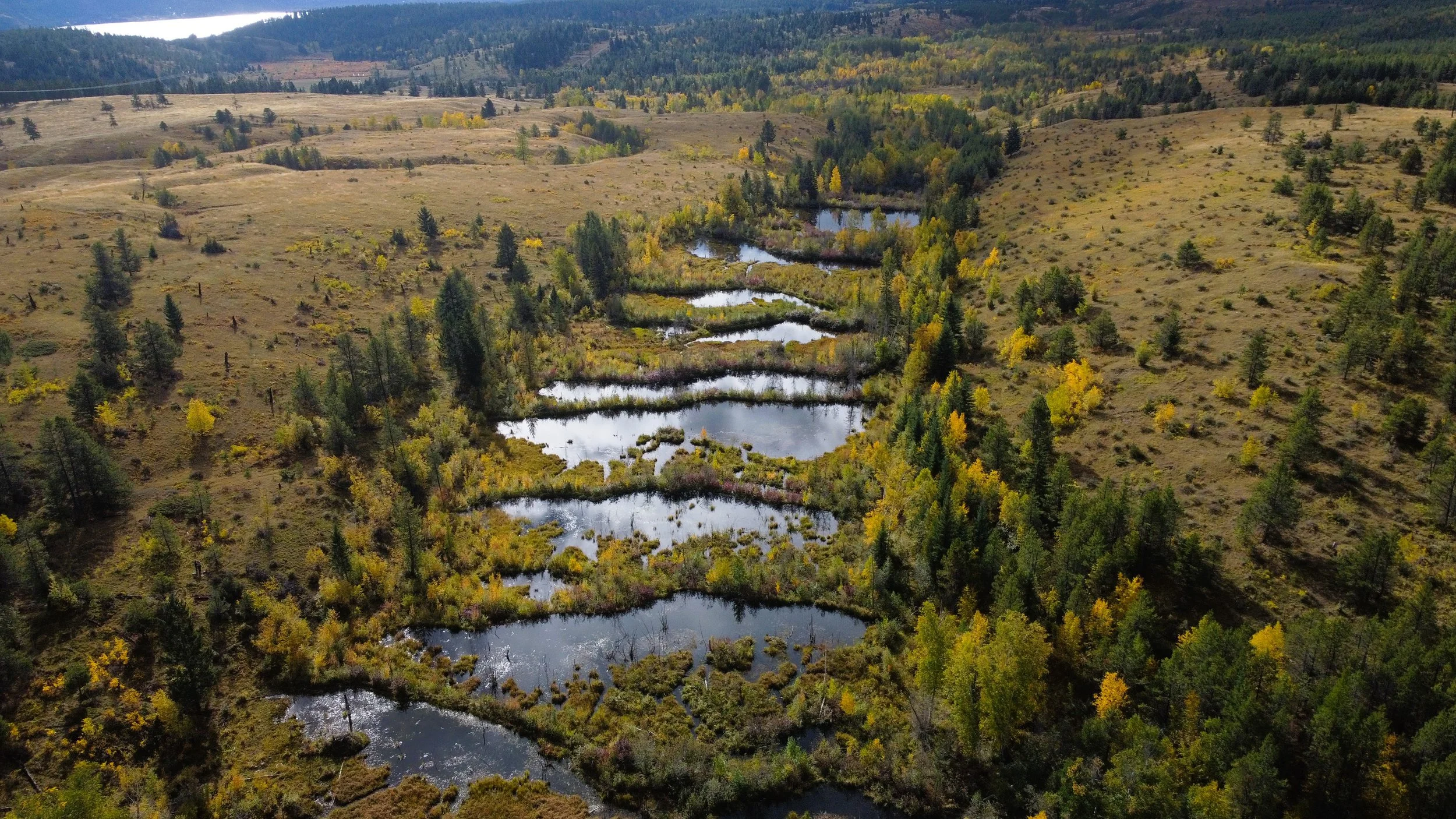
Climate change superhero — Beavers transform landscapes, store large amounts of water, and create important wetland habitat for other wildlife in the upper reaches of Marion Creek west of Columbia Lake. — Catriona Leven/Columbia Wetlands Stewardship Partners
Dr. Suzanne Bayley doesn’t just study wetlands — she calls them home. Based in Brisco, a small farming community in the heart of the Columbia Wetlands, Bayley has watched parts of the region harden like a dried-out sponge. One place she used to hike, near the headwaters of the Columbia River, has evaporated, leaving an oval imprint where water once pooled.
“Ten years ago, there were shallow lakes there,” says Dr. Bayley, a world-renowned wetland expert. “Now they’re gone — bone dry. Lakes that used to have lots of birds in them, they’re gone.” Gone too are the riparian-nesting birds and the moisture-dependent plants.
As the climate continues to shift, ecosystems will change or disappear, pushing many species to seek habitat elsewhere. In some areas, suitable habitat no longer exists nearby. Yet when habitats are connected and part of a larger ecological corridor, there is more potential climate change refugia, giving species more options and room to move.
Landscape connectivity has always been important for biodiversity. With climate disruptions already impacting our region, maintaining ecological corridors is more important than ever before. Kootenay Connect Priority Places (KCPP) — a science-based initiative of Kootenay Conservation Program — was built on this premise, with the aim to sustain and connect exceptional places of biodiversity in the Kootenay region.
KCPP drew on the expertise of conservation ecologist Greg Utzig to analyze how climate change will impact the Kootenays’ ecological corridors; Utzig has spent the past forty years analyzing landscapes across the region. He has travelled almost every valley in the region on foot or by air: his knowledge of the interconnectedness between lands and waters runs deep.
According to Utzig, climate projections are largely the same across the region, whether in the Creston Valley or the Columbia Valley. “In the coming decades, average temperatures are going to go up anywhere from two or four degrees,” Utzig says. “And that is going to override everything everywhere.”
Increasing drought, smaller snowpacks, more wildfire: the East and West Kootenay already see these trends. Over time, these changes will reshape the hydrology and ecological mosaic of landscapes that, to the average eye, has had limited variation over the past thousand years. In some places, valley bottoms may turn into a grassland-steppe ecosystem, akin to the areas much further south like southern Idaho or Utah. For plants and animals to survive and adapt, they will need to shift their ranges by relocating to higher elevations or migrating farther north.
“Nature needs to move,” says Marcy Mahr, Kootenay Connect Manager for Kootenay Conservation Program. “Plants, painted turtles, grizzly bears — as the climate changes, everything will need a place to go.”
In 2019, Mahr co-authored a report with grizzly bear biologist Michael Proctor identifying a network of 12 ecological corridors across the Kootenays. She emphasizes that for people to prepare to mitigate climate change impacts, they need to know what actions to take — and this is where Utzig’s climate analyses come in. Although ecological corridors across the Kootenays will be experiencing similar climatic trends, the impact on each area will vary.
“As temperatures go up, places that hold water are going to be important in the Kootenays,” says Utzig. “Riparian areas, wetlands, and headwater streams help keep connectivity within a corridor. If these ecosystems are damaged or dry out, the opportunity for species movement breaks.”
One shift Utzig details in his analyses has to do with increasing vapour pressure deficit. Appreciating this process takes a basic understanding of plant photosynthesis — something most may remember from biology class. Put simply: the drier the air, the more evaporation occurs. If a plant cannot keep up with the demands of evaporation, it shuts down photosynthesis, regardless of how much moisture is in the ground. Drying trees and plants with drying soils are fodder for intense wildfire, which releases more carbon into the atmosphere, which of course feeds climate change, which causes more evaporation — and so the loop continues.
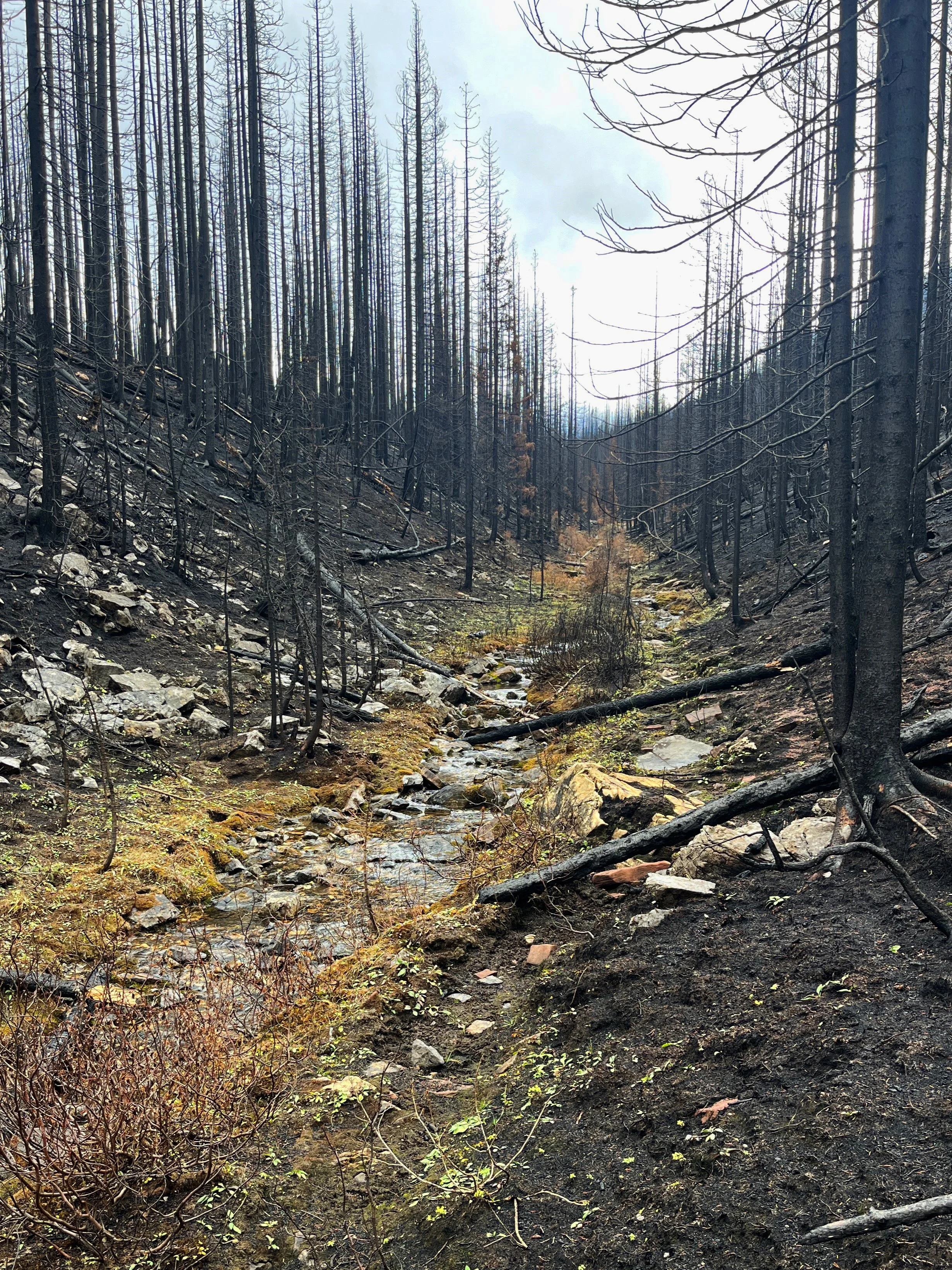
Too hot to handle — The 2024 wildfires severely burned the upper Coyote Creek watershed which starts in Top of the World Provincial Park and feeds the Lussier River — Greg Utzig/Kutenai Nature Investigations
Long ago, the greatest obstacle to ecological connectivity in the Kootenay region was its topography: mountain ranges running north-south like a set of rocky ribs. These natural barriers have always made it hard for low elevation species to easily move east to west. Over the past century, humans have upped the difficulty by adding in highways, roads, clear cuts, residences, and agriculture. “We’ve also dammed the rivers,” adds Utzig, “and filled the valleys with reservoirs. It’s complex.”
Despite this fragmentation, at least a dozen potential ecological corridors remain in the Kootenays. As climate change progresses, these areas have the best chance of supporting landscape resilience — if the habitat is there.
“The general idea with connectivity corridors is to keep a reasonable distribution of high quality and secure habitats in a landscape,” says Mahr. “It’s not saying there can’t be any development or activity in them, but that development and land use has to be compatible with maintaining a diversity of connected habitats for wildlife.”
Utzig recently completed an analysis for the Columbia Lake Corridor, one of KCPP’s ecological corridors. This broad area spans from the Rockies to the Purcells, and includes the dried-out lake where Dr. Bayley used to hike. She and her team at Columbia Wetlands Stewardship Partners have been studying wetlands in the upland west benches of Columbia Lake, and their findings highlight how Utzig’s climate assessments are not just future projections — they are already happening.
Bayley shares that “of the 17 wetlands visited, only five had surface water.” Most of the land in the study area is owned and managed by land trusts, either The Nature Trust of BC or the Nature Conservancy of Canada. For these groups and their conservation partners, understanding the current state of wetlands and future predictions helps to plan out next steps.
“We know that the remaining wetlands and the beaver dams that maintain them are particularly important for keeping water on the landscape,” says Bayley. “This type of data can sharpen our focus, directing restoration to have the most benefit.” While it’s unlikely water will return to the completely dry lake, it’s possible that — with the right actions — some wetlands will stay moist.
For every ecological corridor assessed, Utzig prescribes the same top action: embrace uncertainty. “It’s essential that people understand the history of the area,” Utzig says. “To know how things functioned in the past and have changed, are changing, and will continue to change in the future.” While many of his recommended actions may seem directed at land managers, they’re relevant for anyone wanting to learn more about what their community needs to do to work within the big picture.
“We’re all responsible for the future,” says Mahr. “As property owners and communities, what we do on the ground matters.” Mahr explains that seeing the landscape around us as a whole is important because this is the scale at which climate change is impacting humans, water, forests, plants, and animals.
Drawing on Utzig’s assessments, she adds, “by protecting wetlands for water storage, retaining riparian habitat and deciduous trees for moisture, shade, and fire breaks, and treating our communities’ forests to prevent catastrophic wildfire, our actions can boost resiliency of the places we love.”
To learn more about the Columbia Lake Corridor’s climate assessment, visit: kootenayconservation.ca/columbia-lake-climate-change-adaptation/
For more information about Kootenay Connect Priority Places, visit: kootenayconservation.ca/kootenay-connect-priority-places/
~ Sponsored Content Written by Emily Nilsen, Nelson-based Writer and Consultant
Find this full-length story and more in The Trench’s Spring/Summer 2026 edition: