

Casting Call
On rivers and streams around the planet, mankind’s fascinated quest beneath currents has spanned ages of empire and aristocracy. Ardent angler, Mike McPhee, reflects on the deep allure of fly fishing — and the East Kootenay’s extraordinary place amongst it all.
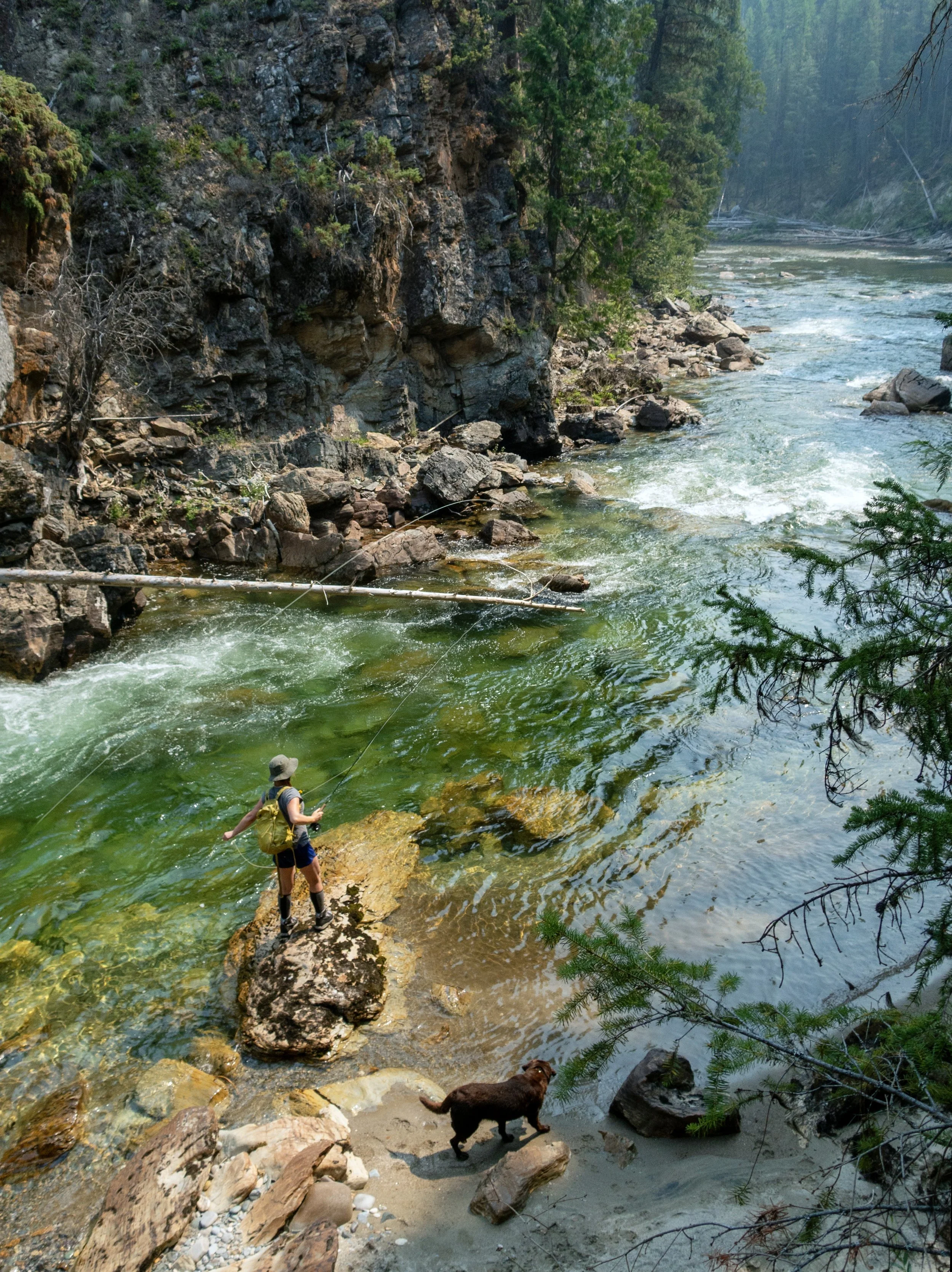
Island Girl — Fernie angler Jackie McCullough makes a sublime cast on the Skookumchuck River. — Mike McPhee Photo
Murmuring, babbling, and soothing: the sound of moving water achieves a mysterious task that moves something deep within us. There is no other sound in nature that compares. It draws you in from afar and can hypnotize you. Its meditative qualities have been understood since ancient times. There’s a reason the spa plays its whispering soundtrack during treatments. Stepping out into a steady current, its audio can wash away all concern of the modern world’s bustle. The fog of screen time and sensory overload dissipate, and something else takes over. One enters a time-warping trance. Five hours seems like one.
Fly fishing is an inexpensive form of healthcare, to be certain — but it’s more than that. It’s an art that can lead to obsession; a never-ending lesson that involves immersion and exploration in nature, and often an expansion of mindfulness. It’s a zen-like endeavour punctuated by moments of adrenaline. And then there’s the trout: feisty and alluring quarry that just happen to prefer the same habitat that I do — clear and cool mountain rivers, quiet places, and the remarkable Kootenay wilderness.
From Fernie to Kimberley to Golden, the rivers and creeks of the East Kootenay are simply a trout stalker’s paradise; a fly-fishing trout highway of sorts. The magic is in the water. Freshly birthed creeks often start as ice and snow high in the Rockies and Purcells on either side of the Rocky Mountain Trench. The valley bottom provides a reprieve, allowing creeks and streams to shift to a lower gear after many of them come tumbling out of the mountains full of youthful vigour. They then join with their brethren into more significant rivers, such as the Kootenay and Columbia, on their long journey to the sea.
Paul Samycia, a longtime river guide and owner of the Elk River Guiding Company in Fernie, knows this landscape well. “East Kootenay waters have some unique qualities that make them special, and different from other waters in the northwest,” Samycia says. “Many of these rivers we fish are in close proximity to the glaciers they originate from and are true freestone rivers. This leaves them in complete control of mother nature — and that’s pretty cool for such accessible waters.”
Though the term is often overused, it’s my opinion that the trout waters of the East Kootenay are indeed world-class — and entirely underrated. At this point, aficionados will hope that I stop discussing these superlative streams to preserve their secrets. I would point out in response that there are many hundreds, if not thousands, of kilometres of creeks, streams, and rivers throughout the region — as well as hundreds of lakes for anglers. In a lifetime of exploring, one could not fish all these waters. I know … because I’ve been trying.
The Kootenays have always drawn explorers and those seeking raw wilderness and untamed mountains. Those who need to see “what’s around the corner” often end up in these parts. These traits are part of what has driven my fly-fishing affliction, to be sure. Immersion in nature on its own is good for the soul; it heals and inspires. The uninitiated should be warned, there is a dangerously addictive quality to fly fishing that may strain relationships and work schedules.
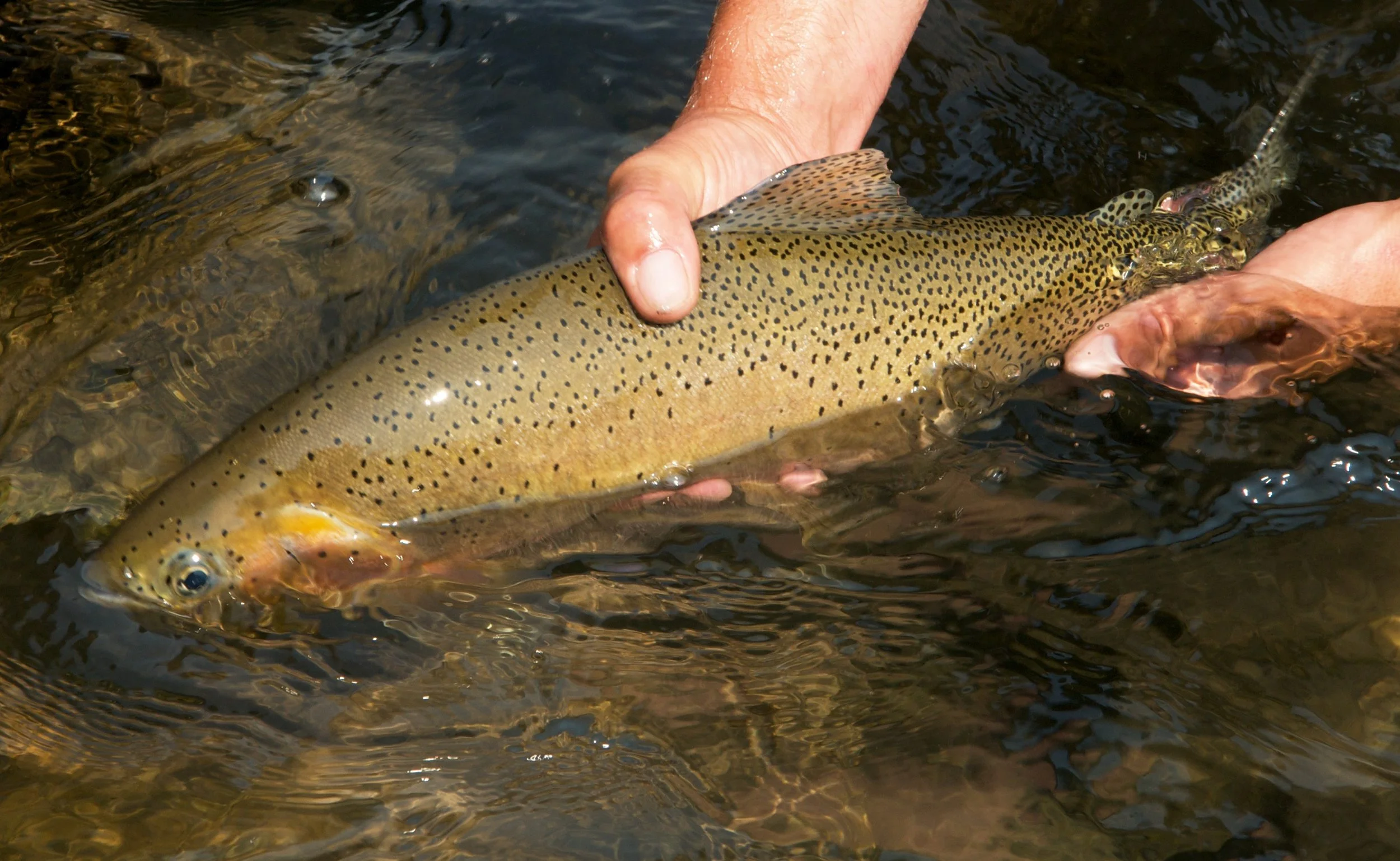
Handled With Care — Thriving in clean and seemingly inhospitable waters alike, a cutthroat trout is gently released back into a stream. — Mike McPhee Photo
Initially, the endeavour can be a bit frustrating, as you take your first casts and perhaps catch yourself in the face with a fly. You will curse the wind and shrubbery for sure. One should consider tangled line and making close friends with local trees part of the learning curve. Tying flies on the line also takes a bit of patience before proficiency sets in. Once past the initial pain points, something else takes over: quiet moments in the car, the liminal space between sleeping and being awake, and time at the work desk may start to be filled with thoughts of rising trout.
Another addictive and gratifying quality of the endeavour is the endless process of improvement and education. From casting to entomology, the learning curve continues as far as you want it to. This is not like other sports where you often hit a plateau and coast along in your comfort zone. Learning to cast is also a lesson in patience. Watching someone proficient at casting is inspirational and artful and can push you towards betterment.
Bushwhacking is not for everyone, but if you are willing, there may be the reward of untouched and seldom-fished waters. Finding magical pools and places on a small creek can feel like winning the lottery. These trout-holding spots often change year to year, making exploration of last year’s favourite spots a new endeavour. There is often an intimate and surreal sensation when coming up to a new or known pool. I often stand and watch, taking in the scene, absorbing the moment. This act of observing which insects are flying around, and hopefully seeing where in the pool some trout might be rising, sharpens the senses. A splash and or mouth slurping off the surface gets the heart racing.
In these instances, patience is necessary. You don’t want to go throwing lines and flies around willy-nilly. Stalking and sneaking up to get close to a rising fish activates some primordial part of the brain; perhaps a holdover from our hunter-gatherer days. The heart races and sweat beads as you near your quarry. Landing a well-aimed fly upstream from the riser, and letting it float overhead in as natural a presentation as possible, can lead to that exhilarating moment all the work has led to. Watching a colourful trout slowly come up from its hideout, follow your fly, and finally grab it not only provides a shot of adrenaline, but is deeply gratifying.
As you might imagine, entomology, or the study of insects, plays a significant role in angling’s learning curve. Mimicking trout food is the key to tricking the trout into your offering. You may see a seasoned angler staring at the water above a creek or looking under rocks to see what’s happening. They aren’t crazy: they have learned to observe, trying to figure out what the trout are feasting on. “Matching the hatch” is a term often heard: this refers to trying to figure out what insects are hatching at any given time during the day and trying to match that with the arsenal in your fly box. The goal is to be at the right place at the right time, and offer the right fly to your quarry.
I can think back to the first time that I was at a perfect spot on a river when a hatch started and trout began their rush to the bug buffet. It was late afternoon and the sun hit a certain pool, warming the water just enough. The insect life suddenly went into overdrive — and so too did the cutthroat trout. Catching several of the large rising beasts in short order changed me from a curious, novice angler into the fully obsessed one I am today.
These hatches occur only at certain times of the day when water temperature and air temperature are perfect for insects to hatch. Nymphs (juvenile insects) often lie at the bottom of a creek or river in wait for this perfect moment of elements coming together. They then rise through the water column, metamorphose, hit the surface, and emerge into a flying insect. These magical moments do not last long; often an hour or less is all you have. Depending on the exact insect, it could be midday or early evening. On warm summer days, you may be treated to multiple hatches with a few types of insects throughout the day. Other conditions, such as a light rain, can also start a hatch and subsequent feeding frenzy.
The Elk, Kootenay, and Columbia
The Elk River is perhaps the most famous of this area’s waterways. It has been called one of the top dry fly-fishing rivers in North America — and for good reason. Starting as glacial ice high on the B.C. and Alberta border and Continental Divide, it flows south for 220 kilometres, gaining strength along the way before entering Koocanusa Lake. Anglers come from all over the world to experience the beauty of its freestone magic.
Most of the commercial guiding on the Elk River is done by drift boat. These flat-bottomed dory boats are maneuverable, can navigate shallow water, and are perfect to cast a fly line from.
“Westslope cutthroat trout are almost always eager to take a dry fly on the Elk, but recently there has been a new obsession with bull trout,” explains Samycia. “Having both these wild, native species available makes the Elk a destination that has fly anglers coming from around the globe to wet a line.”
There are about six sections from Sparwood to Elko that can be accessed by a solid day’s float. No boat, no worries: there are many walk-and-wade sections to wander, easily accessed by the highway that runs parallel to the river for a long stretch.
For those willing to put in the extra effort, there is always more to explore off the beaten track. The river holds large populations of bull trout and Westslope cutthroat trout, and many of the tributaries of the Elk are also trout havens. Some have become famous in their own right, such as the Wigwam and the Michel.
To the west, the mighty Kootenay River starts as a small affair in the Rockies, in the national park that bears the same name. The river winds its way in and out of the park, picking up volume along the way. Flanked by impressive mountains, it then enters the Rocky Mountain Trench at Canal Flats where it mellows a bit. This section of the lower Kootenay can be a bit on the murky side for part of the year, as it winds through the valley bottom and mud flats, but by mid-summer it’s often unclouded and fishable. By fall, it’s lower, clear, and inviting.
Creek outlets on the Kootenay are often a favourite spot for various species to hang out and await your offerings. Many tributaries of the Kootenay are also well-known trout waters. The St. Mary, Bull River, and Skookumchuck River are all extraordinary in their own right.
Starting at Columbia Lake, we have the legendary Columbia River. Though dams now block their return, salmon used to come all the way up to Columbia Lake and were an important resource for the Ktunaxa and Secwépemc peoples. Exiting the lake, the Columbia begins as a small creek. By the time it reaches Golden, it’s a substantial river of breadth and volume. For anglers, the Columbia, its tributaries, and the many lakes that dot the Columbia Valley have been gaining popularity and a reputation for large bull trout.
“The area surrounding Golden offers incredible fishing opportunities that aren’t available in many corners of the world,” says Dave Burns, a seasoned guide at the fly-fishing outfit The Golden Gillie. “From dry fly fishing on intimate streams, to sight fishing big stillwater rainbows, or chasing huge migratory bull trout — there are some truly memorable experiences to suit every angler.”
It should be noted that many of the East Kootenay’s streams have a special designation with specific regulations. These classified waters have been deemed extraordinary and deserving of extra protections: they require an additional permit on your annual fishing licence and are, for the most part, catch and release only. A few very special waters, like the Michel and Wigwam, have a limited number of open days and a lottery system for out-of-province anglers.
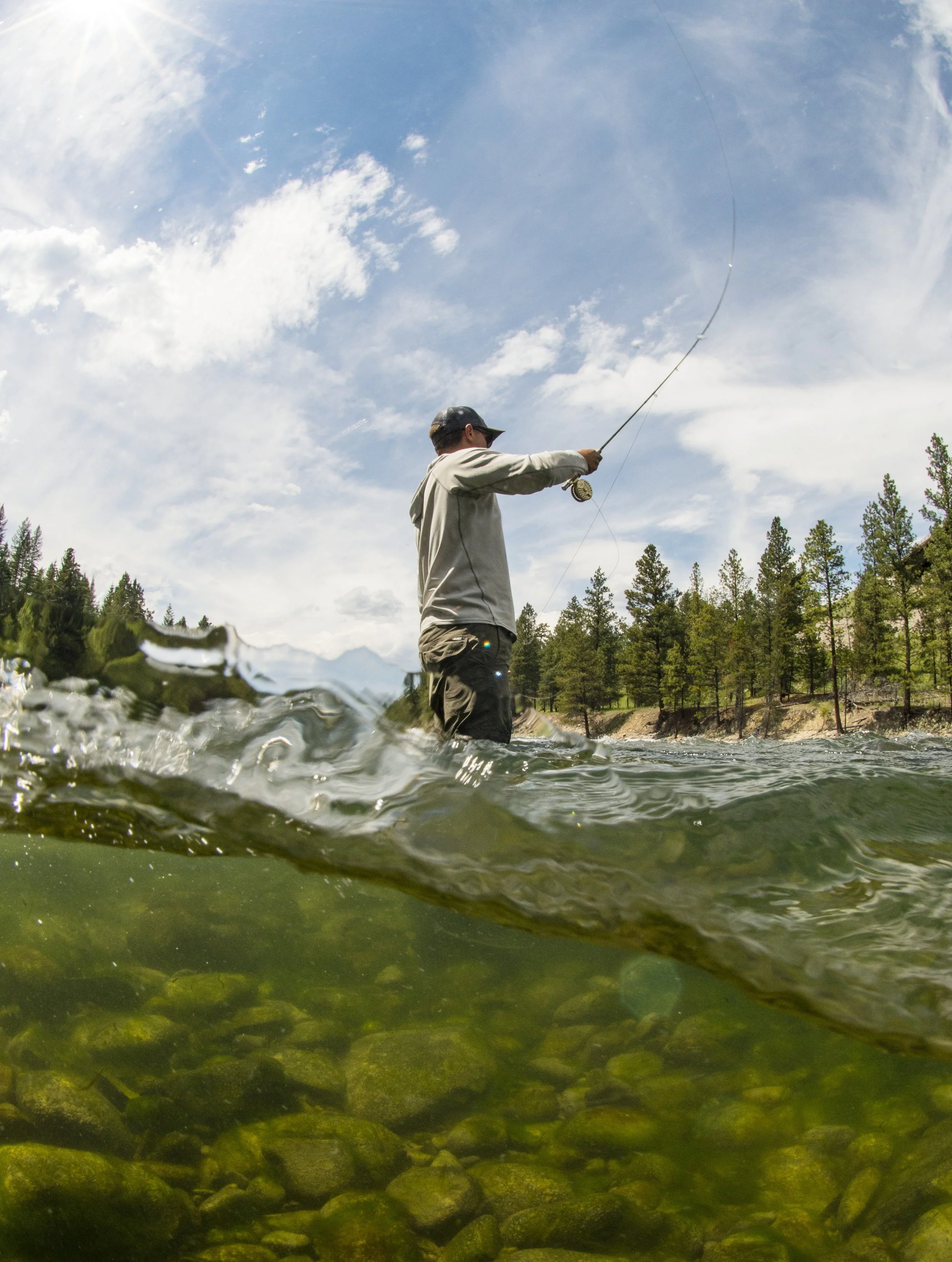
Deep State — Brennan Lund, on and under the St. Mary River. — Mike McPhee Photo
Ode to Trout
In my respectful opinion, Westslope cutthroat trout are the true “mountain trout” species of North America. Some look down upon the cutthroat and say they don’t get as large as other species; that they are too easily fooled by an artificial fly and don’t fight as hard as other species. And truth be told, other species are more difficult to fool and easier to spook. Brown trout, for instance, are notoriously frustrating in their selective eating and weariness of anglers.
Cutthroat, though, love eating off the surface. They spend more time looking up than any other trout species, and they can’t resist a good dry-fly buffet. Cutthroat can often be found in what might seem, at first glance, to be an inhospitable ecosystem. They thrive in high altitude alpine creeks and lakes. They’re extremely hearty and it never ceases to amaze me to find them in the nooks, crannies, and upper reaches of a watershed. They require cold, clean water and often hang out in small creeks that do not look “fishy” at first glance.
Because of these more challenging conditions, they grow a bit slower than their other trout cousins, and are a bit more vulnerable to overfishing and ecosystem disturbances — hence why many of the area’s streams and creeks are classified waters and catch and release only. The Elk River watershed contains the largest population of Westslope cutthroat left in North America. For these reasons, anglers are encouraged to keep them wet when catching them, treat them gently, and put them back as quickly as possible.
Bull trout are also native to the region’s waters. Ironically, they are cons and not trout at all — they’re from the char family, which becomes very apparent when they spawn in the fall with their bright orange bellies and white-tipped fins. They get much larger than cutthroat: it’s not unusual to catch 15-pound bull trout in the Kootenay and Columbia rivers. They also take over many small creeks and streams every fall as they head to their spawning grounds.
While on a rare occasion bull trout might take a dry fly off the surface, they are much more likely to aggressively hit a big, submerged streamer fly. The tactic anglers often employ is to cast weighted streamers into a deep pool, or run and retrieve the wet fly at a medium speed. This mimics smaller fish, such as cutthroat and whitefish. The adrenaline rush one gets when one of these large river sharks comes darting out of the depths at your streamer is something that sticks with you. These apex predators also love the clean, cold streams that the region offers. Though endangered in other places, the East Kootenay holds good numbers in most of the significant waterways.
Rainbow trout are also residents of the region. In the neighbouring West Kootenay region, Kootenay Lake is home to the legendary Gerrard rainbow trout, which grow to be the largest rainbow variety in the world. Other sub-species also lurk in our waters as their ability to grow fast makes them especially popular for stocking in the smaller lakes of the Kootenays. Though not native to many of the creeks and streams they have made their way into, rainbows easily hybridize with cutthroat, producing “cutbows”. There are ongoing conservation efforts to keep their habitat separate.
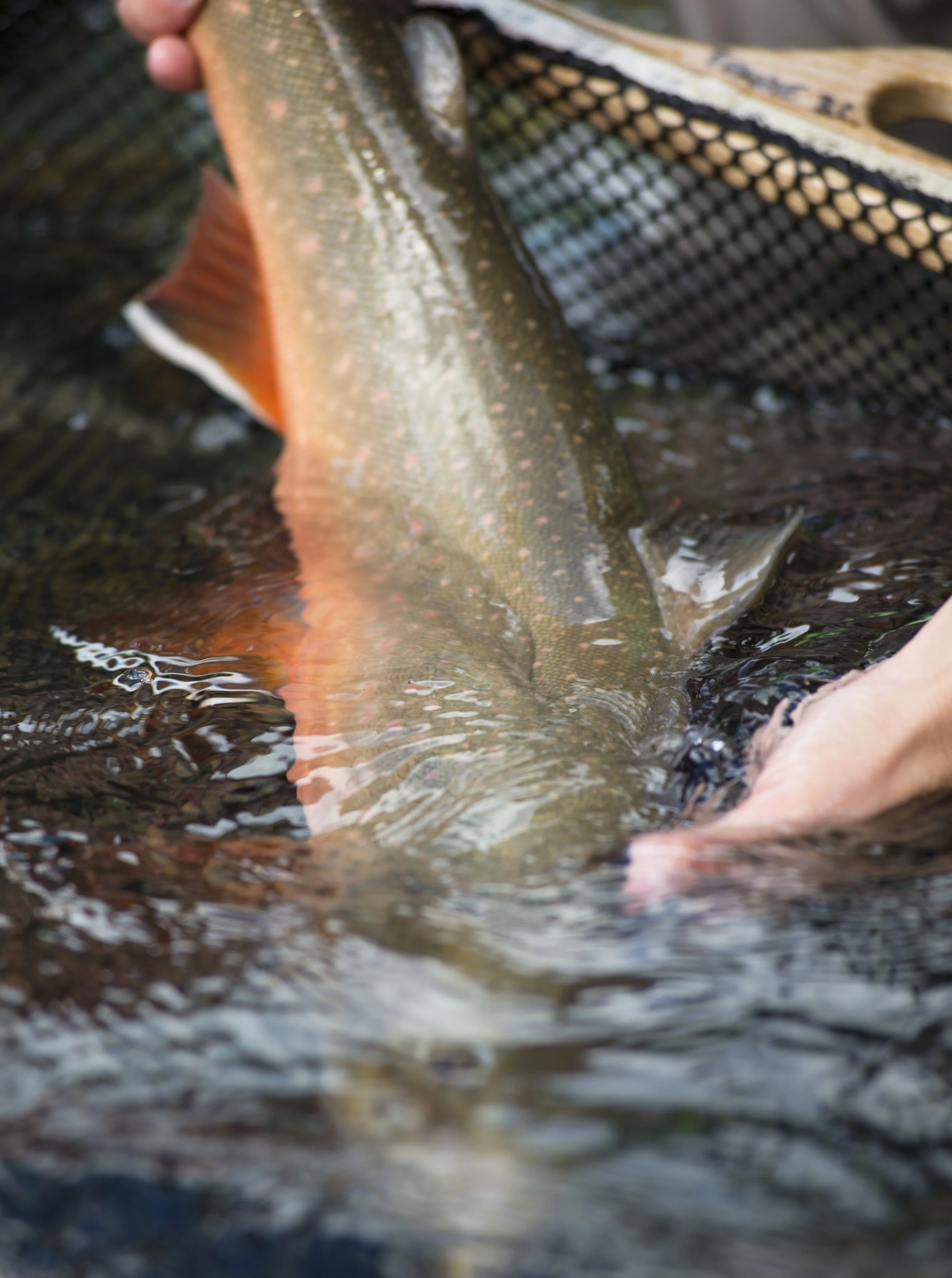
Bullish — Bull trout, considered part of the char family, can be identified during spawning season by their bright orange bellies and white-tipped fins. Bull trout grow considerably larger than cutthroat. — Mike McPhee Photo
A Fascinating History
Deep in the fog of hominid history, humans noticed fish that were a bit harder to catch with basic fishing methods. They likely noticed this quarry feeding off the surface of rivers and streams. There’s an illustration from an Egyptian tomb from 1,400 BC of what looks like a stonefly and an ancient angler fishing on the surface of a stream.
Two thousand years ago, the Roman nature writer Aelian wrote what many consider the first description of fly fishing. He describes Macedonian anglers using red wool around a hook, with two attached feathers from under a rooster’s wattles, to trick spotted fish — likely trout — into taking the artificial fly from the surface of a river.
Deceiving trout with artificial flies seems to have taken on new meaning and began growing into a sport in the late Middle Ages with a brief mention in a manuscript from the 1400s. First printed in 1653, The Complete Angler is often credited with first documenting fly fishing for sport and its association with nature.
The Chalk streams of England and the rivers of southern Scotland are where things really started coming together in the 18th century. Bamboo rods and horsehair line were the tools of the day and anglers started experimenting with fly patterns. Some of the fly patterns we still use today were developed and perfected during this time including Pheasant Tail Nymphs, Woolly Buggers, and Elk Hair Caddis. Tweed suits and a wee dram of whiskey on the side of the river added to this cultured pursuit. Early train travel allowed city folk from Edinburgh, Scotland to start taking the train down to the River Tweed for weekends in search of salmon and trout. The Scottish poet Robert Burns even mentions trout and fly fishing in a few of his famous verses.
Over the last few hundred years, the technology has steadily improved. The introduction of synthetic line, composite rods, and a host of modern fly patterns has accelerated the sport. The Brad Pitt movie A River Runs Through It is credited for a dramatic uptick in interest in the 90s. In recent years, the COVID pandemic helped push people into the outdoors, including spending time on the water trying to coax trout onto a fly. Today’s Goretex and Neoprene waders are certainly more comfortable in the water than tweed suits of the 18th century.
Destination Angling has also witnessed a surge lately as travellers seek new and interesting adventures. Fernie has certainly earned its moniker Trout Town, as anglers from across the globe now add to its visitor economy in a significant way. Cranbrook, Kimberley, and Golden also receive a number of visiting anglers throughout the fishing season.
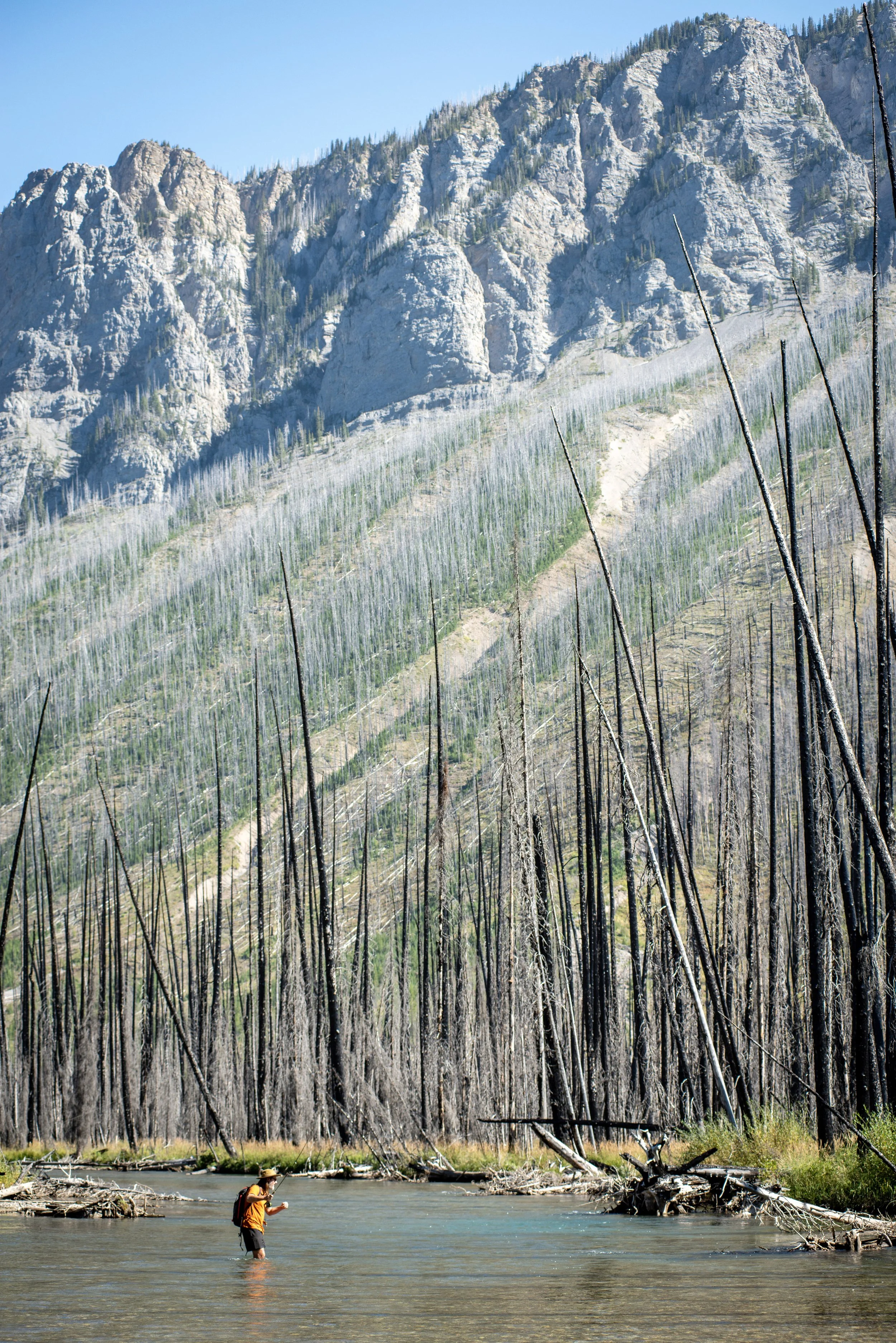
Smoked Trout? — Fernie’s Mike Wilson far south of Kananaskis, AB, in a Rockies range previously swept by forest fire. — Mike McPhee Photo
Therapy - Fully Covered Benefits
There are certain moments that hold in your memory banks for decades, often popping into your thoughts like an old friend stopping by. Late summer sun filtering through the trees, wildflowers and grass overhanging the banks of an intimate stream. That murmur of moving water that projects both energy and tranquillity. The unique and gratifying smell of coniferous forest adds to the full sensory experience. Sitting on a mossy rock on the side of a pool, taking it all in, and watching for trout: that’s my happy place. My therapy session. It’s where my mind often goes when left to its own wanderings.
Shinrin-yoku, the philosophical idea behind the Japanese practice of forest bathing, is a similar notion. Opening the senses and consciousness to fully embrace the sights, sounds, and smells of the natural landscape.
These quiet corners and wilderness endeavours have become even more important of late as the digital world continually encroaches into our spheres. The ability to pursue trout in the Kootenay wilderness is one of the greatest favours I could receive. I’m grateful for the lessons, peace of mind, and personal growth this pursuit has gifted me. I encourage others to get out into the wild, see what's around the next corner, and explore some of the habitat we share with majestic mountain trout.
~ Written by Mike McPhee
Find this full-length story and more in The Trench’s Spring/Summer 2026 edition: