

The Lands Need Guardians
Throughout Secwepemcúĺecw, Shuswap Band Land Guardians lead with ancestral knowledge, grounding today’s ecological care in timeless responsibility and lived relationships with the land.
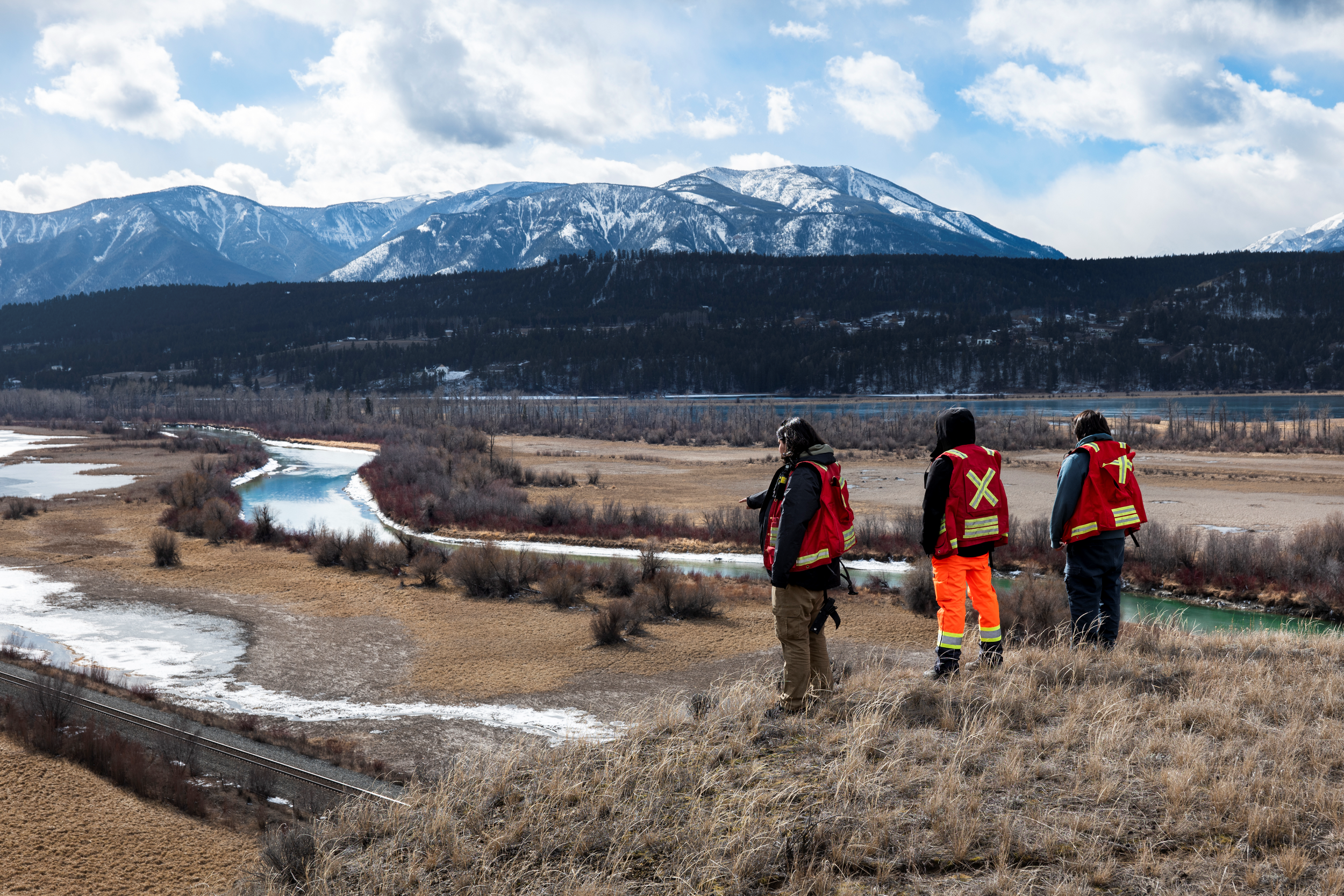
Shuswap Band Guardians Zaylyn Stevens, Lukus Clowers, and Devin Capilo. — Christopher Dehart Photo
If you have ever stood beside a cold mountain stream in early morning light, or watched fog lift off the Columbia Wetlands, you know the feeling; this place matters.
Across the Columbia Valley and throughout Secwepemcúĺecw, the land shapes who we are. It feeds us. It protects us. It draws people here and keeps them here. It holds memory.
But land does not stay whole on its own.
It needs care.
It needs attention.
It needs people who feel responsible for it.
The Shuswap Band has an active Guardian Program rooted in an ancient truth; caring for the land is a duty passed from one generation to the next.
The lands need Guardians.
Not just because policy requires monitoring. But because relationship requires presence.
Long before British Columbia existed, Secwépemc people governed these lands through laws grounded in respect, reciprocity, and restraint. There were protocols for harvesting, for movement across territory, for protecting sensitive places. There were teachings about taking only what was needed and ensuring abundance for those not yet born.
That responsibility has never disappeared.
What has changed is the pressure.
Forestry roads cut deeper into habitat. Recreation increases in fragile alpine areas. Mining exploration expands. Water temperatures rise. Wildfire seasons grow longer. Each impact may seem manageable on its own. Together, they reshape landscapes.
Guardians stand at that intersection, between past and future, between development and protection.
“As Guardians, it is our responsibility to steward and protect our lands, waters and everything that lives there. In this new age, our culture and way of life have changed significantly. Bringing back our cultural knowledge and instilling it in our stewardship practices will help our future generations not only preserve the cultural aspects, tangible and intangible, but also provide teachings for the next generations to come, ensuring they are still there to enjoy and experience. If we do not protect what little remains, we will be putting the lands, water, animals, plants, cultural landscapes and practices in danger of being lost. Throughout the past few hundred years, the First Nations have lost so much. The Guardians that each nation can have out on the land is a great step forward in preserving our lands, waters, animals, plants, cultural landscapes and cultural practices," says Joshua Martin, Director of Culture and Heritage.
Guardians are on the land in every season.
They test water in streams that once ran colder.
They document wildlife tracks where migration routes are narrowing.
They record culturally significant sites that do not appear on provincial maps.
They speak with elders about respectful management.
Sometimes their work looks technical with GPS units, field notebooks, and habitat assessments. But beneath that is something deeper. It is about noticing.
When you walk the same valley year after year, you see change others might miss. You know when a stream sounds different. You know when berry patches are thinner. You know when elk are moving earlier than they used to.
That kind of knowledge cannot be downloaded. It is built through relationship with the land.
Across Canada, programs supported by the Indigenous Guardians Program have shown that Indigenous stewardship strengthens conservation outcomes. Here at home, it also strengthens something less measurable but equally vital: connection.
“I find working on the land super rewarding. Every day in the field feels like a new adventure. As a Guardian, I get to learn more every day and protect what I value most," says Christopher Dehart.
Clean water does not distinguish between reserve and non-reserve. Wildlife corridors do not end at property lines. Smoke from wildfire settles over all of us.
When Guardians monitor habitat, restore access protocols, or flag environmental risk, they are not protecting one community at the expense of another. They are protecting a shared future.
Many residents value intact landscapes, but may never see the quiet, consistent work behind that integrity. Guardians make sure that commitments to sustainability are not just words in planning documents. They translate them into action on the ground.
They also carry stories. Place names. Teachings. Language. When youth work alongside Elders as part of the Guardian Program, knowledge moves forward. Cultural continuity strengthens ecological care.
Because when you understand a place as family, you treat it differently. It would be easy to describe the Program as an environmental initiative. But that framing is too small.
It is an expression of jurisdiction.
It is an investment in youth.
It is climate resilience in practice.
It is reconciliation made tangible.
Most of all, it is a statement; the land is not an afterthought.
In a time of accelerating change, we need more than regulations and designations. We need people who show up consistently, attentively, and with long term accountability.
Today, they are trained, organized, and working every day, walking shorelines, climbing ridges, listening to rivers, ensuring that the places we love remain whole enough for the next generation to stand in awe of them too.
The lands need Guardians.
And whether we realize it or not, we all depend on them.
~ Written by Justine Burns
Find this full-length story and more in The Trench’s Spring/Summer 2026 edition: