

Let Her Rip
Trench writer Jacquie Moore suits up with three noteworthy East Kootenay snowmobilers, each of them exemplary in their personal commitments to stewardship, heritage, and formidable hoonin’.
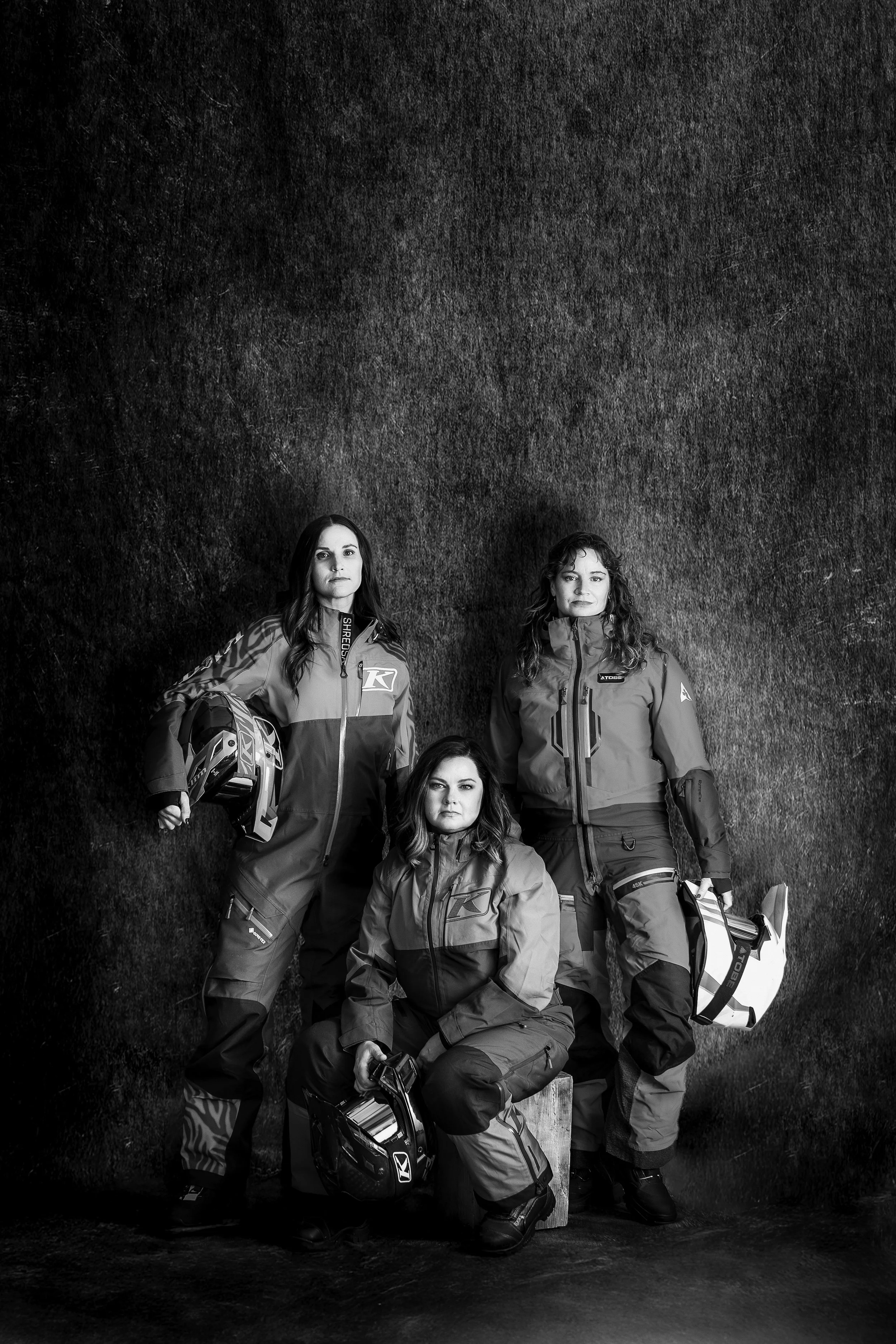
Well Suited — Clockwise from left, snowmobilers Gabby Hockley from Moyie, Kimberley’s Alex Ibbotson, and Nicole Matei from Fernie. — Nicole Leclair Photo
Snowmobiling has long carried certain stereotypes:
Loud engines, mostly male riders, and a reputation for being hard on the landscape. But that image is quickly changing. Riders like Gabby Hockley, Alex Ibbotson, and Nicole Matei are part of a growing wave of women carving their own lines through the backcountry and redefining what the sport looks like.
For them, snowmobiling isn’t just about horsepower: it’s about access, beauty, and stewardship. A sled can get you places only a lucky few will ever glimpse from a helicopter. It’s about community, too, as friendships are forged on mountain ridges and in powder fields where skill and stoke matter more than anything else. And it’s about strength because snowmobiling is a full-body sport that calls for athleticism and confidence, making it a natural fit for those who want a challenge and a thrill.
Women aren’t just joining the sport, they’re shaping it. Through skill, visibility, and pure joy, they’re proving snowmobiling isn’t just for a few. It’s for anyone with a sense of adventure and a love of winter.
Gabby Hockley
When Gabby hits the snow, it’s not just a day outside; it’s a full-body, full-throttle love affair. A professional rider for Polaris, Hockley spends her winters carving through pristine backcountry terrain, often with a photographer in tow capturing her signature powder turns.
“I grew up on a sled,” she says with a grin. “I got my first snowmobile when I was three.”
Raised in Cranbrook, B.C., Hockley grew up with weekends that revolved around riding. Her parents snowmobiled all her life, her brother also rides, and now she’s carrying that legacy forward.
“It’s been a family thing my whole life,” she says. “We’d head out every weekend — rain, snow, whatever — and just ride.”
While she laughs easily, there’s serious athleticism behind Hockley’s effortless-looking powder arcs, and it’s clear she trains hard. “It’s definitely really physical,” she says. “Honestly, it’s the reason I work out. If I’m in shape, I can ride longer, push further, and have way more fun. People don’t always realize how much strength and stamina it takes.”
Hockley isn’t a competitive racer; her professional status comes from her work as a factory rider for Polaris where she is featured in marketing campaigns and photo shoots. She’s also been sponsored by the gear company Klim since 2013.
“It’s all about showcasing the sport,” she says. “We shoot in these incredible places. It never stops blowing my mind how quickly a sled can take you to views that feel completely wild.”
When she’s not riding for a photoshoot, she’s just … riding. A lot. “Last season, I probably got out 60 times,” she says. “An average day is leaving the house at 8 a.m. and getting home around 7 p.m. I go with my husband maybe ten times a year, but mostly I ride with friends and my brother.” Hockley explains that the snowmobile community is both super-tight and extremely welcoming. “Most of my closest friends now I met through sledding.”
Hockley’s husband may not be quite as obsessed with the sport, but he’s along for the ride — literally. “He’s a photographer, so he loves coming out and capturing the beauty of it,” she says.
To make her snow-filled lifestyle work, Hockley is also a realtor. “Real estate gives me flexibility. If there’s a storm coming or a shoot with Polaris, I can just go,” she says.
For Hockley, snowmobiling isn’t just a sport. It’s adventure, exercise, adrenaline, and community wrapped in a cloud of cold smoke and mountain air.
“Once you try it, it’s addictive,” she says. “It’s like skiing a perfect powder line, except that you’re not waiting for a chairlift. You’re the engine.”
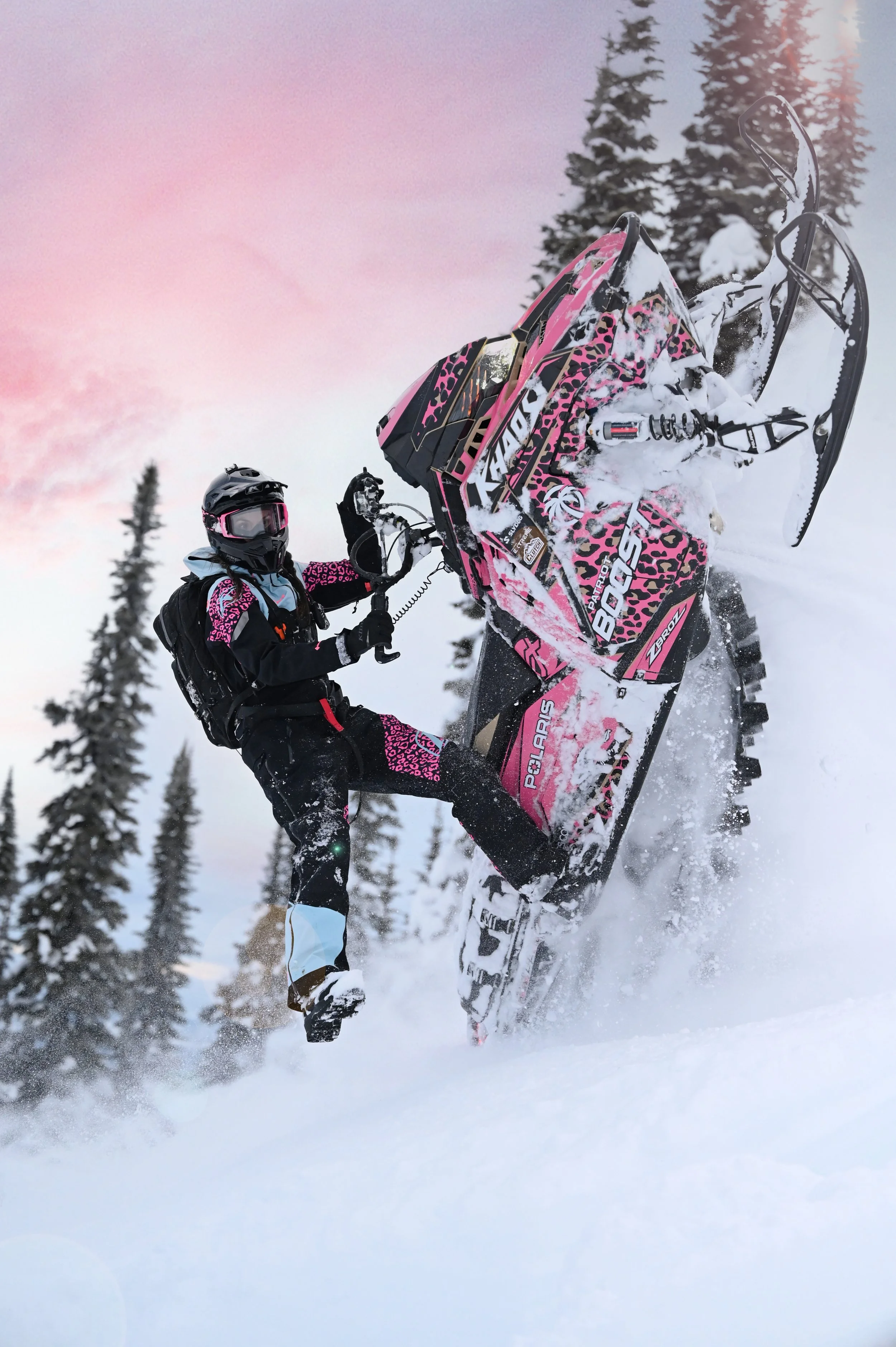
Wheelie Good — Hockley is a factory rider for Polaris where she’s featured in marketing campaigns and photo shoots. — Isaac Hockley Photo
Alex Ibbotson
Alex calls herself a “snowmobile practitioner.” It’s a title that raises eyebrows — and that’s part of the point. “It means I make a living on a snowmobile,” she says. “There are professional snowmobilers who focus on marketing and sponsorships, but my work is about access, education, and equity in the mountains.”
A Métis woman raised near Invermere, Ibbotson grew up snowboarding before she found her calling on a sled. “I wasn’t that into skiing — my parents tried,” she laughs. “But snowmobiling opened a whole new way of experiencing the mountains. It’s exploration access. You can move through terrain in ways that skiers just can’t.”
That freedom is exactly what she’s fighting to protect. “There’s a stigma that snowmobilers are loud and destructive, or lazy,” Ibbotson says. “People assume it’s easy. It’s not. There’s so much work involved just to get out there, including hauling gear, fixing machines, learning the land. And as an Indigenous person, it’s frustrating to see human-powered sports like skiing seen as noble, while we’re treated like we don’t belong.”
Through her company, Indigenous Mountain Culture Inc., Ibbotson operates Canada Backcountry Services offering avalanche training and guided trips at the Lumberton riding area near Cranbrook, as well as mentorship for Indigenous riders. “I’m being hired by Nations to bring avalanche and snowmobile safety training into their communities,” she explains. “It’s about creating self-reliance, reconnecting to land, and keeping traditional skills alive in a modern way.”
Ibbotson’s vision goes far beyond recreation. “Many snowmobilers were trappers. They were accessing territory and keeping a traditional livelihood alive,” she says. “I want to make sure those skills aren’t lost and that Indigenous people are included in how the backcountry is managed and accessed.”
For Ibbotson, the sled is much more than a machine: it’s a vehicle for connection, empowerment, and rewriting the story of who belongs in the mountains. Her leadership reflects this broader mission — transformational change in backcountry culture.
“The future of all snow sports requires respectful, responsible land use, inclusivity, and safety,” she says. “When communities see themselves represented in these spaces, it changes everything.”
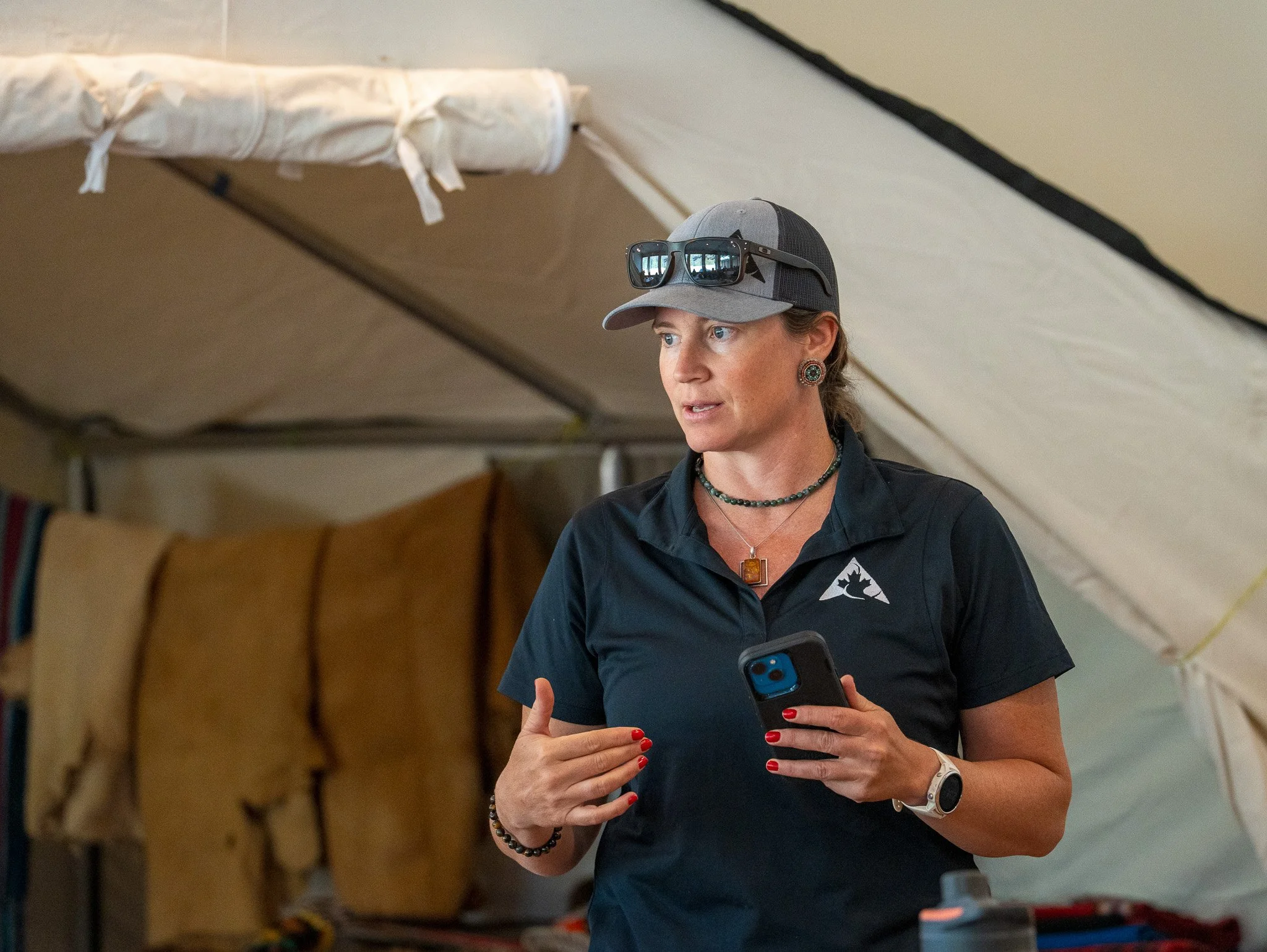
Guide by Nature — Alex, a Canadian Certified Lead Snowmobile Guide, teaching navigation and outdoor safety to the Métis Nation BC youth, with her trapper tent, furs, and art displayed in the background. — David Aguilar Photo
Nicole Matei
From her home base in Fernie, Nicole has carved out a life at the crossroads of safety, storytelling, and snow. A paramedic and a lifelong mountain enthusiast, Matei has spent more than two decades working in outdoor operations — from ski patrol and trail building to mountain safety and, most recently, leadership with the BC Snowmobile Federation.
“People still hold this old idea that snowmobiling is loud or reckless,” she says. “But in reality, we’re some of the most active stewards of the backcountry in B.C.”
It’s a point Matei is proud to back up with facts. The Federation oversees more than 60 snowmobile clubs that maintain 18,000 kilometres of trails, 90 shelters, and nearly 100 staging areas through formal agreements with governments, landowners, and First Nations.
“Our clubs invest countless volunteer hours in signage, education, and habitat protection. We’re not just users of the land — we’re caretakers.”
Matei’s work as the Federation’s programming and marketing coordinator connects those clubs, riders, and partners with each other. She supports everything from safety initiatives and tourism promotion to the stewardship programs that keep the sport sustainable and thriving.
“The volunteers do incredible work,” Matei says. “The Federation’s role is to give them structure and a voice.”
A skilled communicator, Matei has long used storytelling to shift perceptions. Her articles for outdoor publications and the Federation’s Let’s Ride BC platform combine industry insight with accessible narratives.
“Volunteers aren’t out there to toot their own horns,” she says. “I wanted to tell the good stories — to show how much effort goes into maintaining these trails and protecting the landscapes we love.” Matei writes about unique snowmobile adventures, history of the area, events, and, most enticingly, the diverse group of passionate people at the heart of the sport.
For Matei, snowmobiling fulfills a deeply personal passion. “I always want to see what’s over the next hill,” she laughs. “It’s the explorer and storyteller in me.” Whether it’s catching sunlight on fresh snow or spotting a whitebark pine in bloom, each ride renews her connection to the land.
Matei’s initiative and leadership helps future generations of riders build their own passion for the sport and connection to the mountains.
“If you want to protect something,” she says, “you have to love it. And to love it, you have to experience it.”
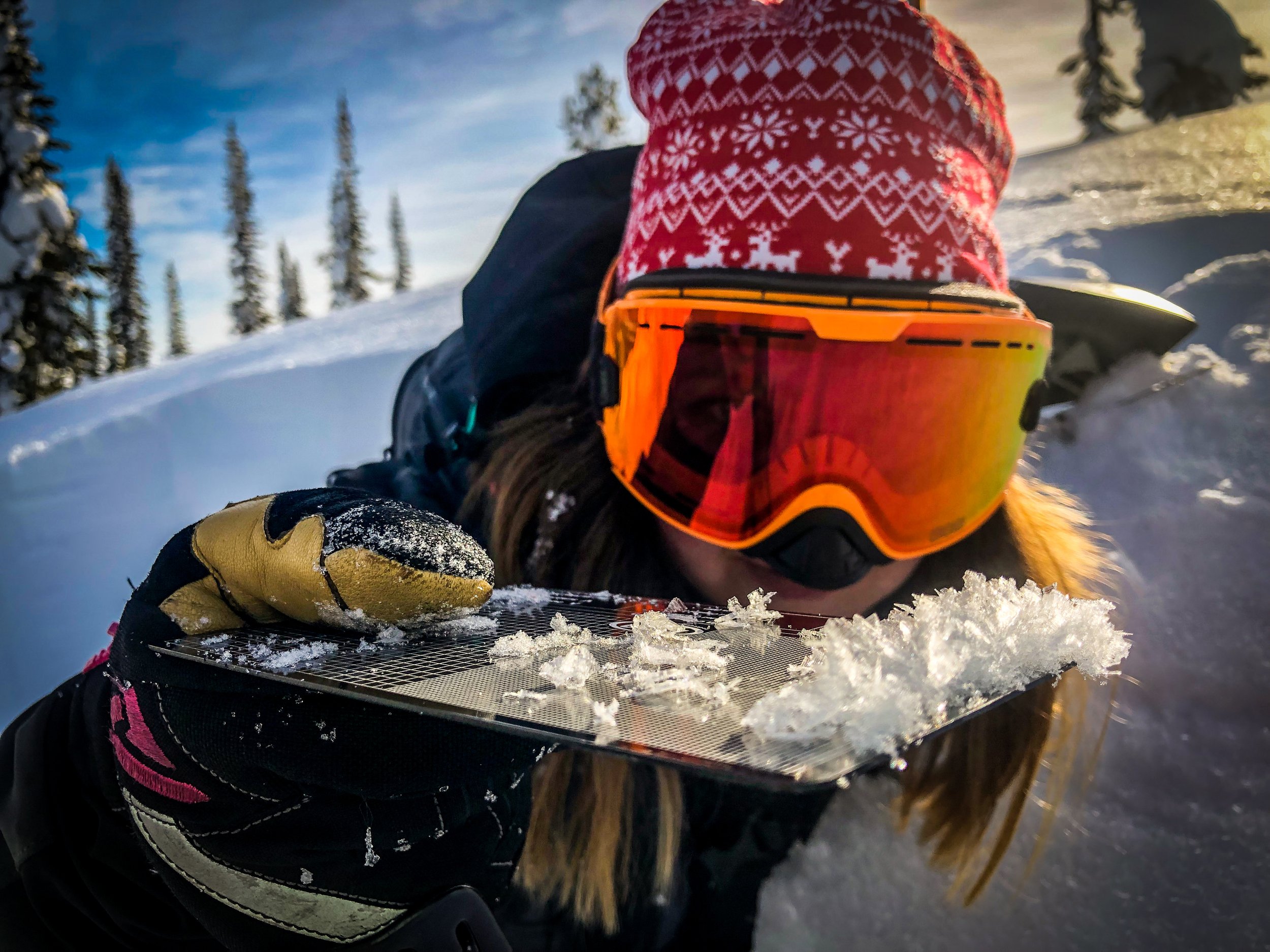
Frosty Flakes — Nicole, seven here in the midst of a snow layer stability test, was recently hired on as marketing boss for the BC Snowmobile Federation. The organization oversees 60 snowmobile clubs that maintain 18,000 kilometres of trails and 90 shelters. — Contributed Photo
~ Written by Jacquie Moore
Find this full-length story and more in The Trench’s Winter 2025/26 edition: