

The Rockers & The Roamers
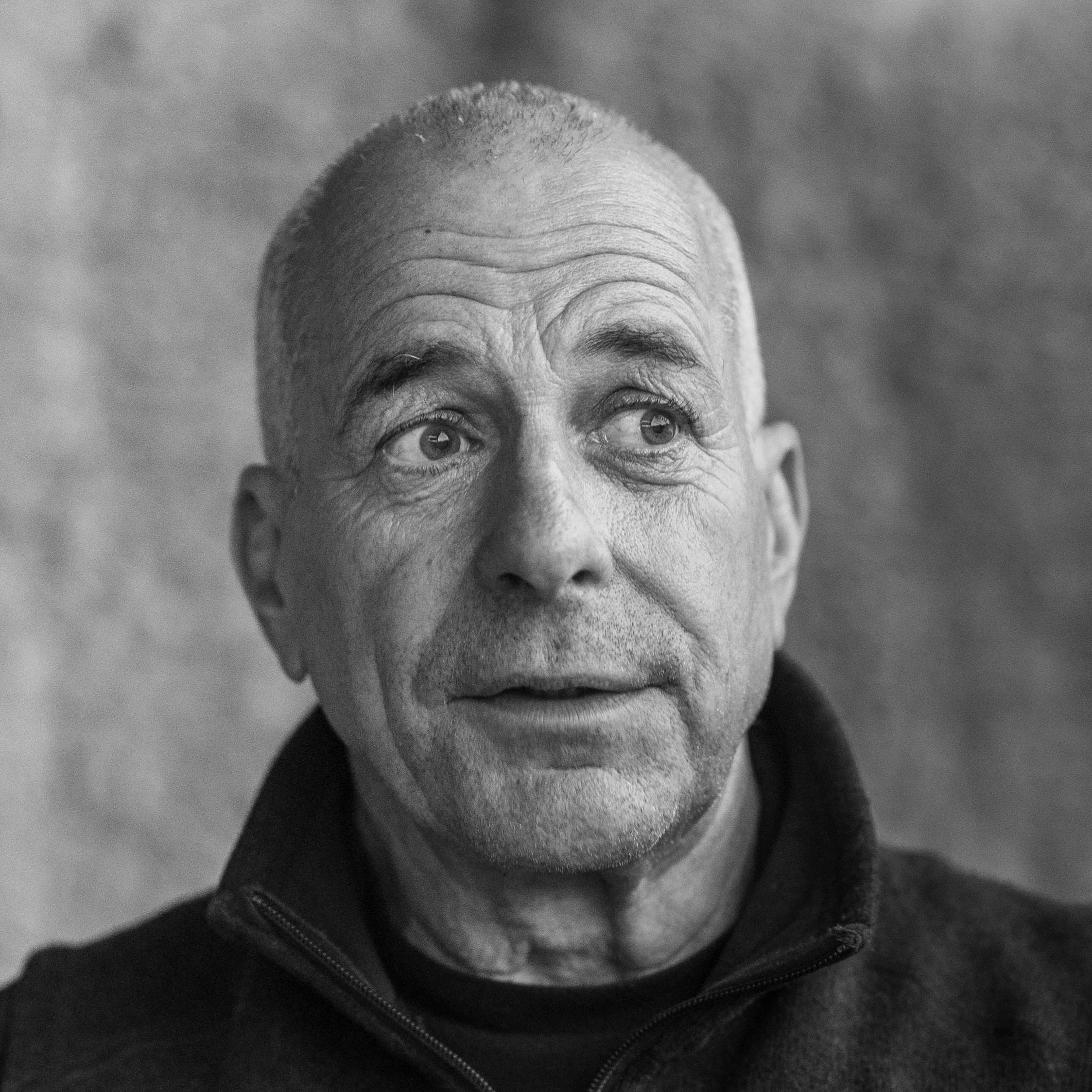
Born into a 1960’s U.S. military family, Leo Downey was inspired by his jet pilot dad, The Doors, and a bible found in the desert. A high-flying career in music and Hollywood acquaintances ensued. Today, though, the former frontman’s life is spent beneath the Rockies’ east front and the heaviest of hooves. How did it happen?
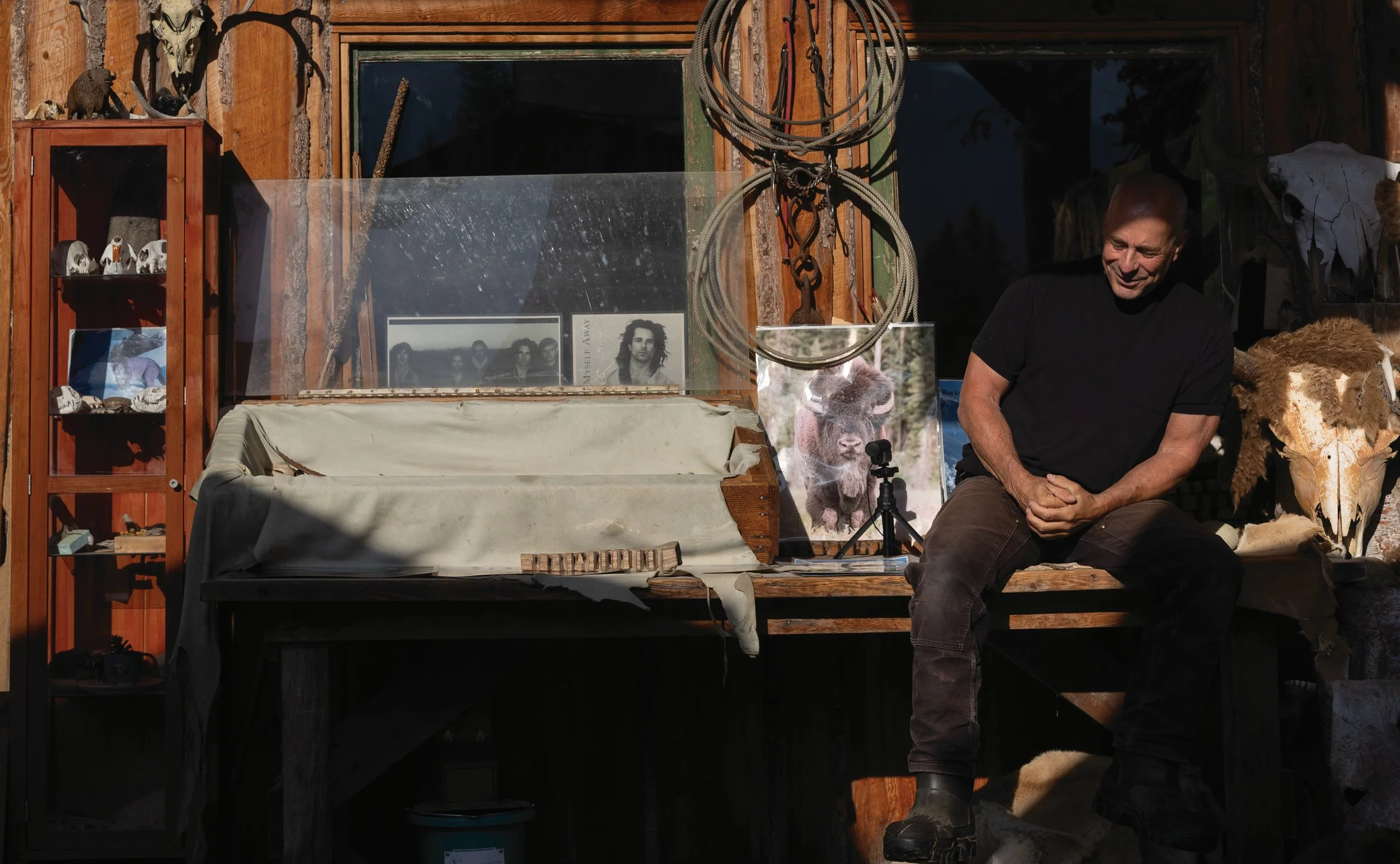
Follow the Herd to … Canada? — Leo Downey invites The Trench into his Kootenay domain, where Hollywood relics share space with hides, skulls, and the hard-won rhythms of ranch life. — Jeff Pew Photos
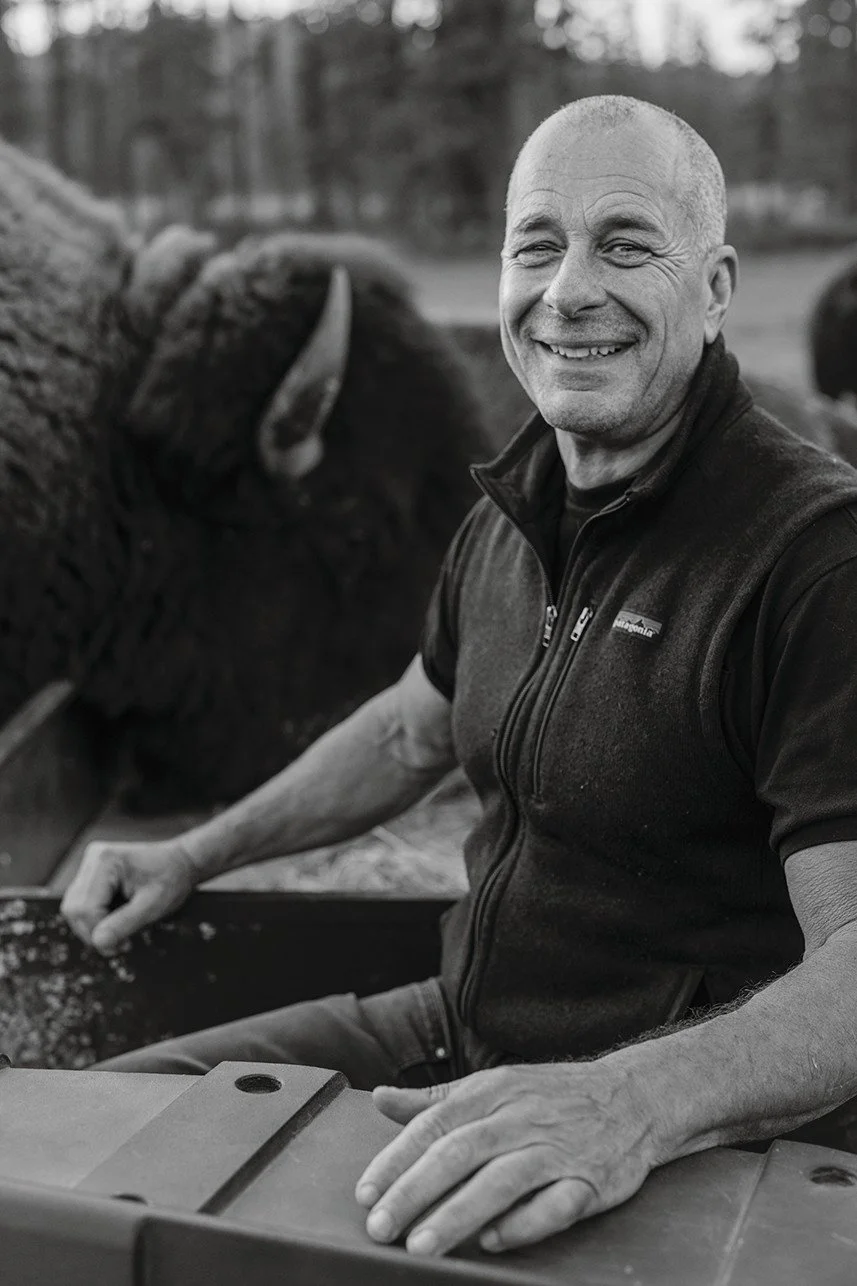
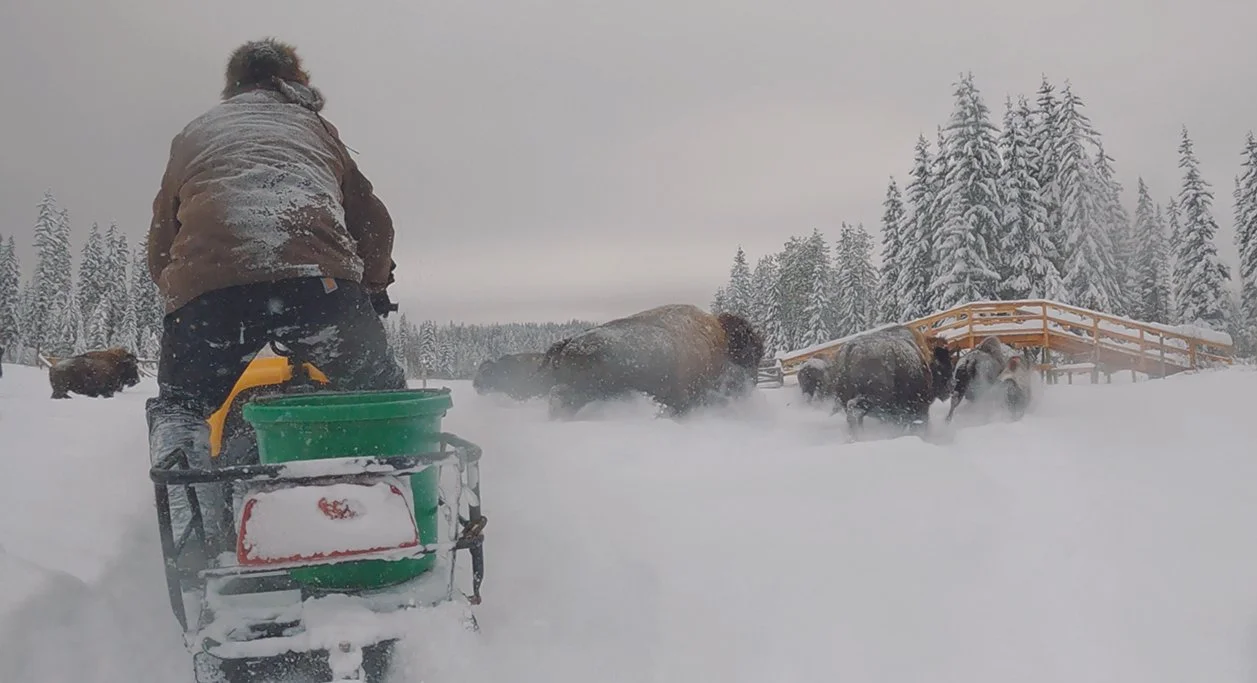
We talk about miracles and monasteries. Rattlesnakes and heartache. Playmates and Bonnie Raitt. We sit on a quad in a pasture shadowed by Hedberg Peak in the Rocky Mountains, a herd of seventeen buffalo grazing among us.
Leo Downey — ex-California rockstar, now owner of Golden’s Rocky Mountain Buffalo Ranch — warns me not to leave the quad as his 2,000-pound lead bull, Chester Jr., grunts, gnaws oats, and nudges my knee. “Don’t touch ‘em either,” Downey advises, explaining how buffalo thrust and twist their horns to gore an opponent. I breathe deep and try not to move.
I first learned about Downey while watching the 2025 Banff Mountain Film Festival short Leo and Chester, a film on Downey’s life. A tale of how he gave up a three-record Sony deal and Budweiser contract after wandering the California desert for eighteen days, where a vision, he says, changed the course of his life and led him to a 100-acre ranch in British Columbia.
Later that night, safe on Downey’s deck, we sit among buffalo skulls and pelts, his band’s late ‘80s albums, and copies of his 2015 autobiography, Soultracker. Downey lives in a work-worn two-story cabin — rough-sawn 2x4 walls, single-pane windows, and a woodstove that can’t beat the January cold.
“There’s ice on the floor in winter,” he tells me. The electric heat barely dents the cold; even the acoustic guitar he’s had since he was sixteen is collapsing under the strain of the seasons.
Dressed in a black T-shirt and jeans, Downey, 65, is built like someone who’s spent a lifetime cutting firewood and hauling hay. He speaks with a youthful tone, smiling, stretching his words as if he doesn’t want to leave anything out.
In Soultracker, Downey describes his boyish charm: “I’ve always had a kind of spirit or innocence of a little boy … that women seemed to find very attractive. I was a friendly dog. I loved everybody, but I also always wanted to face, fight, and do whatever I was most afraid of.”
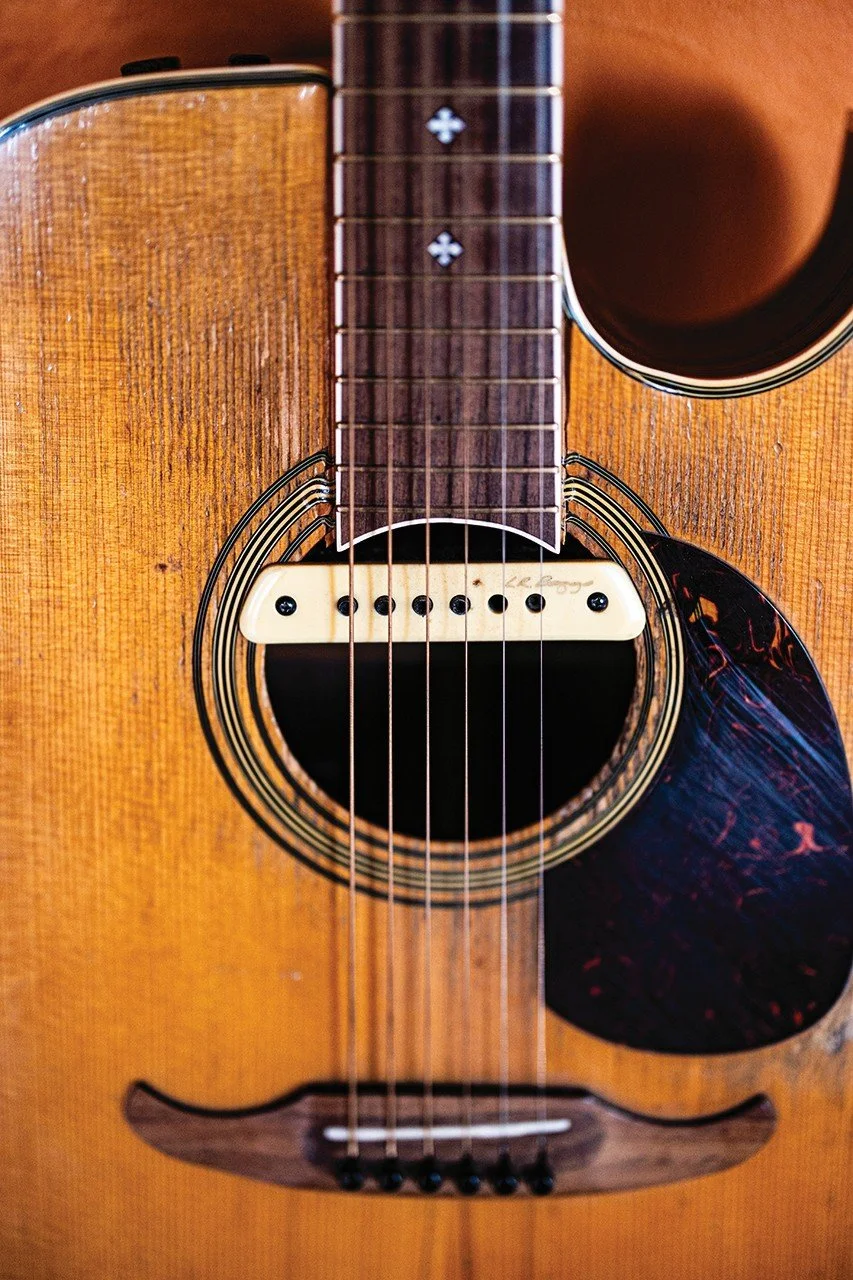
Herd and Soul — The same guitar that Downey strummed as a California teen still sits in his cabin where he shares stories from his life with guests from around the world. — Jeff Pew Photo
The Pre-Chorus Years
Born in Monterey, California, he spent childhood stints in Iceland and Singapore, following his father, a U.S. Navy commander. “Even though I was young,” he says, “Iceland left a huge imprint on me. It’s what attracted me to Canada.” By 1974, his family had settled in Santa Barbara, California, where he fell deeper into music. “I wanted to be a musician since I was a kid, listening to my brothers’ and sisters’ records — Hendrix, Dylan, Crosby, Stills & Nash, Janis Joplin.”
He first heard The Doors’ “Light My Fire” from the backseat of his dad’s Ford Galaxie. “It was night, and I cried for the sheer beauty of it,” he recalls. Later, he discovered Andrés Segovia, widely regarded as the father of modern classical guitar. “I listened to it thousands of times and learned guitar by ear. I couldn’t read music. I just watched my teacher, listened, then began writing songs.” Downey started with instrumentals until, a few years later, he began adding lyrics — inspired, as he wrote in Soultracker, by a “ninety-eight-pound Mexican Catholic hottie with curves at the end of her straightaway that guys would drive off the road for.”
As a teenager, Leo idolized his father — a decorated Navy pilot and commander — and kept his words close. “My dad would talk to me about how the native people survived in the desert mountains where we lived, alone, out there for thousands of years.”
At sixteen, Downey went to see for himself: three days alone in the arid California wilderness, no tent, just a knife and a small sleeping bag. He asked for a sign to guide his life. Beneath some boulders, he spotted a tiny Bible and crawled under to reach it. At dusk, a mountain goat appeared at the lip of a waterfall, vanished, then appeared again. What began as a campout turned into a quest.
“Those first three days changed my whole life. Things happened that aren’t supposed to be able to happen.”
For the next twenty years, the desert became a sacred place where Downey went to listen. He wandered into deep, silent canyons where everything stood still.
“I was following a spiritual bloodline — a communion of ancestral mystics,” he writes in Soultracker. He slept on the ground under the stars, surviving on plants, rabbits, and rattlesnakes, eventually lasting up to thirty days and losing forty-one pounds.
From Stage to Sage
“Loving the truth allows me to go to the centre.” — Soultracker
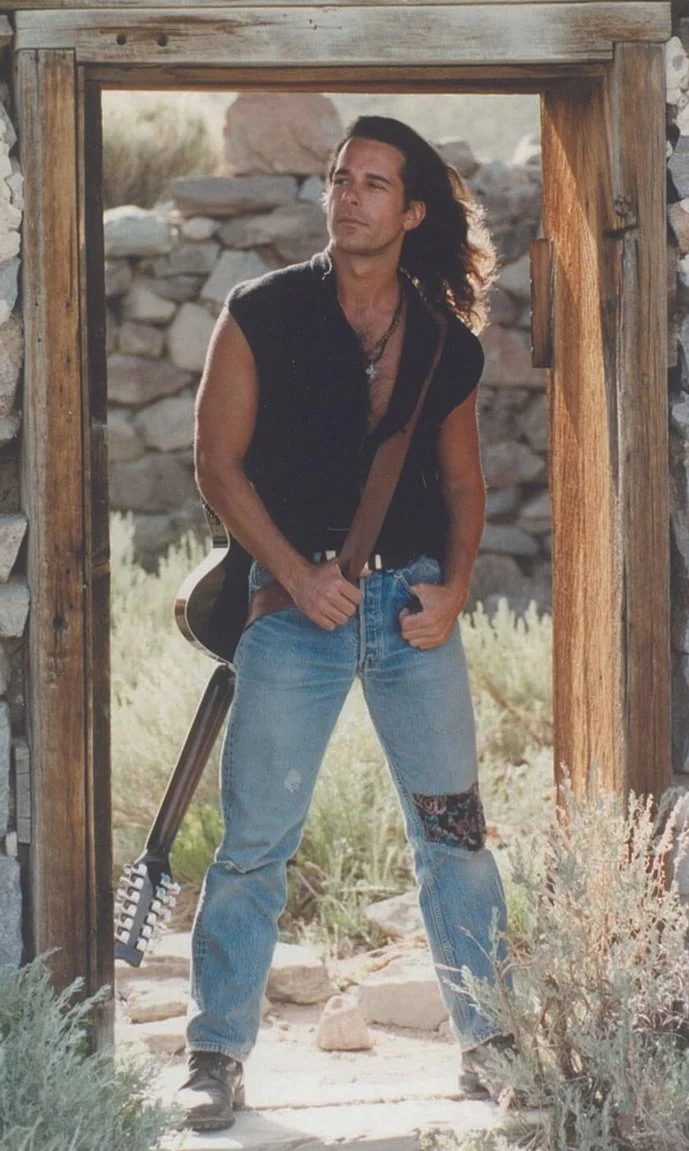
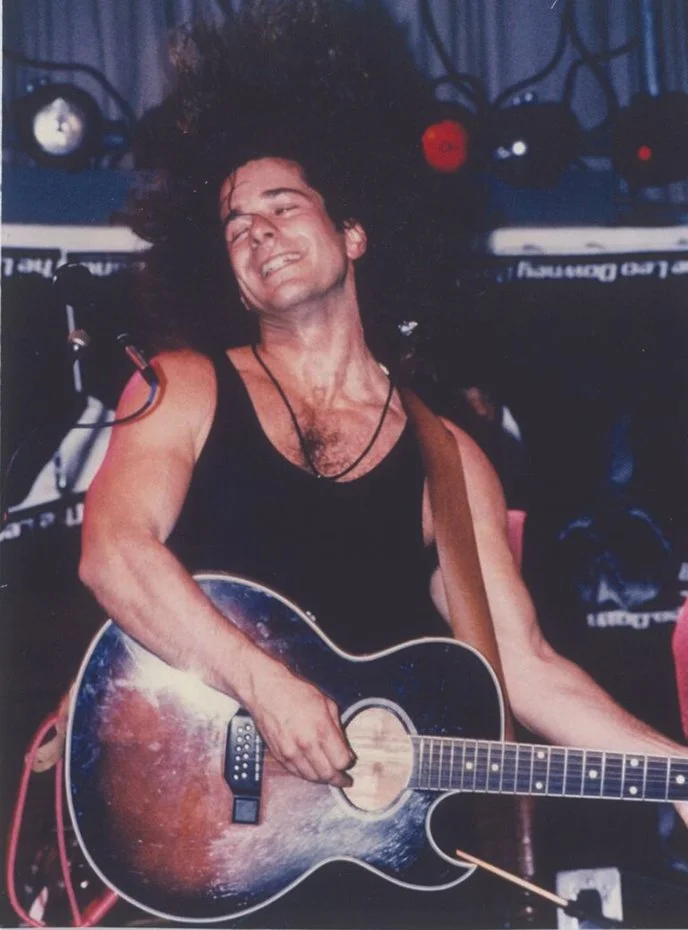
By his twenties, Leo, adorned with flowing romance-novel hair, was fronting a band and living the rock star archetype — clubs to festivals, with crowds swelling from hundreds to tens of thousands.
“We were playing seven nights a week and doing really well,” he recalls. “I had a rock band and drank till dawn,” he writes in Soultracker. “I was born attracted to women like fire in the night. You think the blood doesn’t pump through my veins?”
He dated Playboy’s Miss March 1981 and Ghostbusters’ dream-ghost Kymberly Herrin. While he dated Bonnie Raitt, her album Nick of Time went gold and won the Grammy Award for Album of the Year. When Bonnie was on a private jet with KISS, Gene Simmons asked for a photo with her on his lap.
“Those guys are real road dogs,” she told Downey. “You’re a road dog, too,” which inspired the song “Road Dog” on his Heaven and Hell album.
Downey was living the rockstar dream: he hung out with Jane Fonda and neighbours like Joe Cocker, Michael Douglas, Jimmy Messina, and Joe Walsh. “I thought I wanted all of it,” he reflects.
Yet, at thirty-two, with a three-record Sony offer on the table and a Budweiser promo lined up, he told the band he needed clarity, so he took a pause — and walked into the desert.
“I was living two opposite lives. The band was thriving, but out there, wandering the desert, every breath became a prayer.” He speaks of experiencing visions, dreams, and miracles; says he learned a teaching the hard way: “A man who gets his vision and doesn’t live it is a walking dead man.” On the eighteenth day in the wild, he walked back to the city and told the band he was done. He quit.
Vultures and Visions: The California Condor Recovery Program
“I think one of the purest relationships we have on Earth is with animals, as if created in the image of angels.” — Soultracker
Starting in 1992, Downey pushed deeper into the backcountry. Five ranges back into the Sierra Madre, he found the nearly-extinct California condors — the largest birds in North America. He befriended Dave Clendenen, the biologist leading the California Condor Recovery Program.
“I got involved about six months before they were ready to release the first offspring,” he explains. For six years, Downey helped release the birds back into the House of the Two Suns — a sacred cluster of sandstone caves and deep canyons with Chumash rock paintings — then into the Ventana wilderness, Big Sur, where Downey was born, and later, the Grand Canyon.
The team captured the remaining condors, bred them in captivity, and reintroduced their young. They also captured and relocated wild ungulate herds — elk and antelope — so that vultures like condors could feed on the carcasses.
Following the Herd, Moving North
“When I think about the legendary life and personality — the animating soul — of a dominant buffalo bull, I get the shivers.” — Soultracker
As his condor work wound down, Downey fell in love, got married, and honeymooned in Canada, then later returned to the Columbia River Valley near Golden, B.C. to look for land to purchase. “This place wasn’t advertised. Somebody told me about it,” he says. “I came down the driveway and saw Chester, the lead bull, and five cows.”
Andy Hamilton, the owner who had grown up on the ranch, greeted Downey. In 1998, using his savings, Downey and his wife bought the ranch — including its resident buffalo — and moved north with their newborn son.
The ranch became both livelihood and liturgy. He built cabins, hosted visitors, and learned from the herd each season. In Soultracker, he thanks the neighbours who taught him how to live off-grid: “I didn’t know how to survive in the North,” he explains. “There was ice, snow, and cold. There was farming and buffalo. How to work up and seed a field. How to hunt, skin, gut, cut, eat, and use all of an animal.” Every season, Downey learned something new.
In 2015, his marriage ended and Downey reached a settlement with his ex-wife that allowed him to keep the ranch. Since then, he has harvested buffalo meat, continued with hosting tours, and rented out the cabins dotted in the woods on Airbnb.
Later that evening, when Downey and I say goodnight, it feels like I’d stumbled into a Western movie: a group of ranch hands sits around a small fire, wolves howling in the distance. I sleep in the Bunkhouse cabin attached to the barn, one of four Airbnb cabins on the property, and fall asleep under a mosquito net to a chorus of crickets.
The next morning, I make instant coffee on the deck and finish Soultracker, in which Downey weaves the story of his life with his desert-forged spiritual beliefs. “Miracles affect your orientation,” he writes. “They transform your reality. Every thought, every word you hear, and person you meet … all your desires grow roots in a different kind of earth.”
I join the ranch tour where fifteen people from France, Switzerland, Taiwan, and New York gather by his cabin deck to learn about buffalo. Europeans and Asians are fascinated by the buffalo’s wild, Western mythology portrayed in movies, novels, and album covers. They look prehistoric, massive hump-shouldered Ice Age survivors. They’re a symbol of resilience. Tours run daily, May through September, packed with visitors from around the world.

Leo & The Herd
Although Downey has given hundreds of tours, he greets guests like old friends, as enthusiastic as if it were the first time he’s speaking about buffalo. He talks to us for an hour from the deck of his tiny cabin, then leads visitors toward the perimeter of the pasture, where he calls the herd to the fence with a bucket of oats.
He explains the origins of the ranch and how its original bull, Chester Sr., was a wild bull from Parks Canada. He describes some bull basics: they’re full-grown around ten. An average bull is about 2,000 pounds and a cow around 1,000.
“What makes a buffalo herd, really, is a bunch of cows — mothers. They live their whole life together,” Downey says. “They all know each other’s faces and ranks and enforce it hard, but they rarely injure each other. They belong to one bull called a dominant bull.”
Only the bulls that win fights get to breed, and about 95 per cent of bison bulls never sire a calf. Downey explains the long process of getting the herd to accept him, where he can carefully walk amongst the herd.
“Once they accept you, they can remember your face for over three years without seeing you,” he tells the guests. “It took six years and 15 charges to be able to go in on foot and have them accept me like another buffalo.”
From 2000 to 2015, twenty-five people were injured in Yellowstone after getting too close to bison.”Females inflict more fatal injuries than males,” Downey explains. In 2015, a dry cow who’d lost her calf almost killed Downey. She came from 500 metres out of the trees and kept lunging closer and closer.
“You can’t back up,” he warns guests. “Once you do, they’ll assert dominance and charge you every time you enter the pasture.” He recounts how he yelled, stamped his feet, and threw his arms over her head before she eventually veered. “Then I chewed — acted like another cow — and walked away like a sailboat.”
Bison can run faster than a horse for the first 400 metres and can jump a two-metre fence. Yet they don’t, as home feels safe. Last winter, a grizzly killed two of Downey’s herd for the first time in 27 years, and a coyote took a newborn calf.
Downey raises his buffalo primarily for meat, and the whole process takes place at the ranch. “The best way is with a rifle right out of the herd on the snow,” he explains. “There’s no fear.” A local butcher prepares the meat, which he sells in sides to local families.
The tour turns sombre when Downey explains how he lost Chester Sr. “He was twenty-six in 2012. I hoped he’d just freeze in his sleep, but he couldn’t get up for three days. I had to shoot him,” he recounts. “I got down on my hands and knees in the snow right in front of his face — a tear came out of one eye. He breathed in once, then breathed out his last breath, and I breathed it in. That breath gave me the strength to get through a pretty traumatic time in my life.”
Chester Jr. took over the herd at three. Now fourteen, he’s slowing down a little, which helps the younger bulls get away from him. Still, he breeds all the herd’s females.
Downey now balances ranch life with writing and music. He’s revising Soultracker, aiming for a sharper focus on the visions and miracles that shaped him in his desert quests.
At the conclusion of the tour, Downey demonstrates how to build a bow-drill fire. Two children from the Netherlands giggle as they blow on a tiny ember buried in tinder. Guests purchase Downey’s CDs and linger on the deck.
Before I leave, I hug Downey goodbye. I feel like I’ve made a friend, more an innocent sage than a rock star. As I climb into my truck, he tells me to wait a second, then disappears. He runs back with something in each hand.
“Ground buffalo meat,” he says. “Makes great burgers and pasta sauce.”
In Soultracker, Downey writes, “Life has turned out to be more an art than science. Science looks at what happens. God looks at who’s looking.” In online reviews, visitors to the ranch praise Downey’s storytelling and passion for buffalo. Some call it “unexpectedly profound and moving.” It harkens to a maxim of Downey’s that he often says out loud: “It’s the tiny miracles all around us.”
~ Jeff Pew
Find this full-length story and more in The Trench’s Winter 2025/26 edition: