

The Creators
Thirty years ago, inspired by the Ktunaxa story of Yawuʔnik̓, a horseback expedition of intrepid kayakers trundled up the Purcells then paddled unknown whitewater back down. Today, their film, River Spirit, stands as a work of visionary conservation and high-country radness.
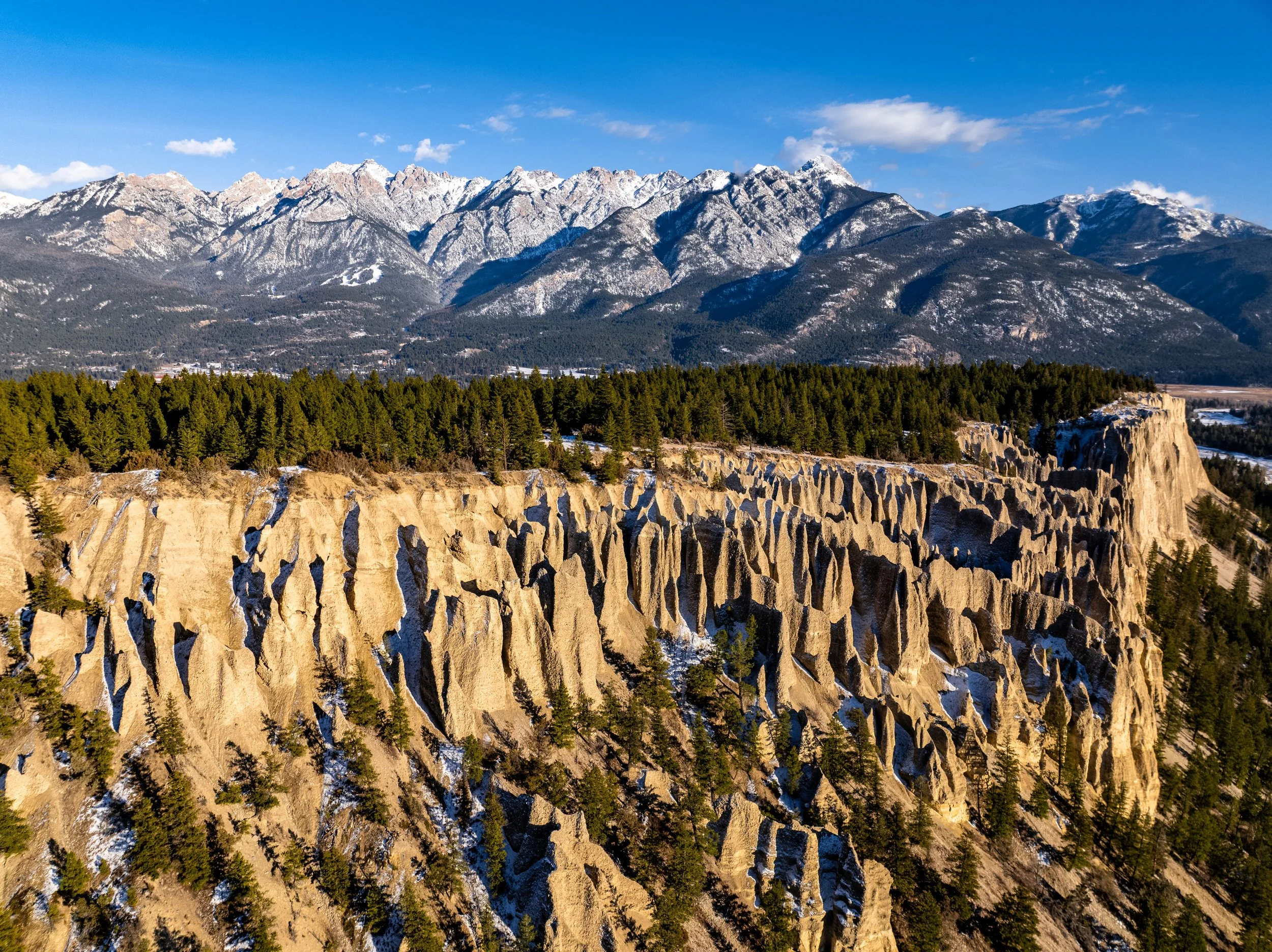
Who Do? — The Dutch Creek Hoodoos, south of Fairmont Hot Springs. East Kootenay environmentalist Art Twomey, filmmaker Frank Paynter, and Ktunaxa Elder Leo Williams borrowed from the legend of the hoodoos for a film that would coincide with the preservation of the Purcell Wilderness Conservancy. — Mat Loyola Photo
In hindsight, it was a bold move: three decades ago, Kimberley filmmaker and producer Frank Paynter embellished a Ktunaxa creation story, weaving it together with the retelling of an exhilarating adventure through the wilderness of the Purcells.
Paynter belonged to a cadre of 1970s and 80s East Kootenay hippies, adventurers, and environmentalists that included the late Art Twomey and his partner Margie Jamieson, who co-founded the backcountry lodge company Ptarmigan Tours. Twomey was many things: a glaciologist, pioneering avalanche educator, outdoor entrepreneur, cofounder of the East Kootenay Environmental Society (which became Wildsight in 2004), and a documentary filmmaker. As an activist, he was instrumental in the creation of the Purcell Wilderness Conservancy. In the mid-1990s, he envisioned an adventure film that would celebrate this roadless and undeveloped mountain wilderness.
The adventure angle was covered: kayakers Jeff Boyd and Anne Marie Fisher had an ambitious plan for a first descent of Carney Creek from its headwaters in the Purcells all the way to Kootenay Lake near Johnson’s Landing. Twomey asked Paynter to produce the film, and after discussing the concept, Paynter thought the film needed more to the narrative than simply documenting a paddling adventure. Paynter had recently finished an environmental film, Still Life With Woodpecker, that featured narrated storytelling by Ktunaxa Elder Leo Williams in the native Ktunaxa language.
It sparked an idea to use an adaptation of the Ktunaxa creation legend of Yawuʔnik̓ as the narrative thread for the film. Yawuʔnik̓ was the giant creature that once swam the great rivers of the East Kootenay, and whose bones are still visible as the Dutch Creek hoodoos, as seen from Highway 95 near Canal Flats.
“I wanted to have the kayakers follow the journey of some baby Yawuʔnik̓ trying to reach Kootenay Lake from their birthplace in the headwaters,” Paynter recalls. “When I told Leo, he laughed and said that it would be okay.”
While the film was in the planning stages, Williams asked a Ktunaxa friend, Margaret Teneese, if she would do the translated English narration to his story. Teneese, now an archivist and language promoter with the Ktunaxa Nation, was uneasy at first.
“There I was in my thirties, telling my Elder that he needed to talk to other Ktunaxa Elders first,” Teneese says. “They told him that our creation story is not for sale.”
But when Williams inquired with his fellow Elders about a potential Yawuʔnik̓ legend adaptation that included some of Paynter’s embellishment, the Elders gave their consent and the project proceeded, resulting in the creation of the film River Spirits.
The film documents an arduous east-west journey through the Purcell Mountains, a wilderness with a long conservation story. The seeds for its protection were planted more than one hundred years ago on an equally epic adventure. In 1908, then-Governor General Earl Grey followed old Indigenous and mining trails up Hamill Creek from Kootenay Lake over a pass and down Toby Creek, following a route now known as the Earl Grey Trail.
So impressed was Grey with the nature and scenery that he petitioned B.C.’s premier at the time to push for a national park. Nothing happened. Prospecting and fur trapping continued in the area and in the 1960s and 70s, logging companies began pushing roads up into pristine Purcell valleys. This sparked protests in which Twomey and Jamieson were front and centre. Public pressure eventually led to the creation of a 1,300 square-kilometre conservancy in 1974. Twenty years later, the B.C. government expanded and reclassified the conservancy as a Class A provincial park, encompassing 2,000 square kilometres, covering six major watersheds flowing east to the Columbia Valley and three draining west to Kootenay Lake.
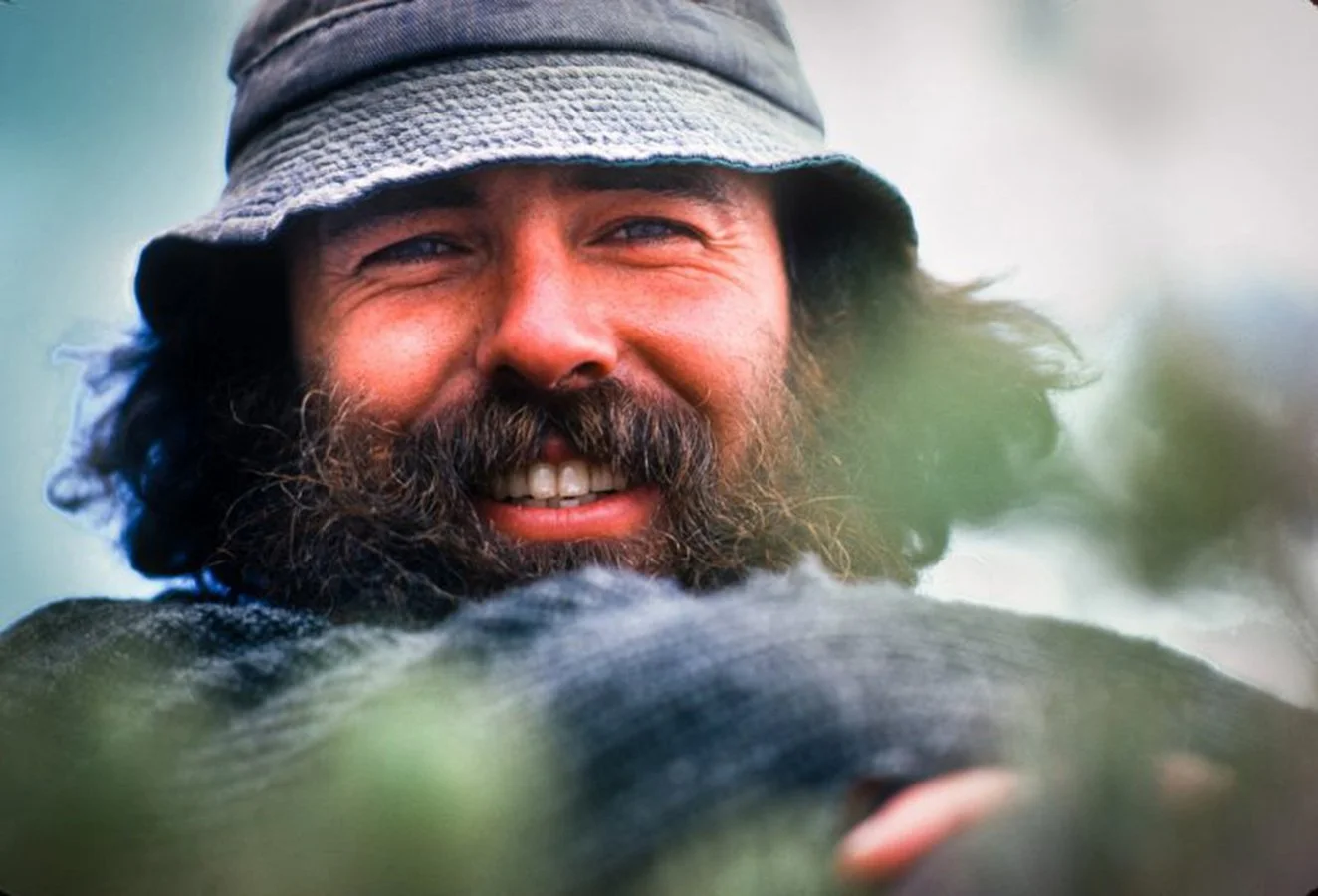
Vision Quester — In the mid-1990s, Art Twomey persuaded Frank Paynter to produce an adventure film about the wild lands that would become the Purcell Wilderness Conservancy. Twomey passed away in a helicopter crash in 1997. — Pat Morrow Photo
The timing of River Spirits’ creation coinciding with this new designation was poignant and not lost on Twomey, who had been alongside Paynter behind the cameras. With kayaks strapped to the backs of two packhorses and Jamieson as wrangler, the film begins on the lower reaches of Dutch Creek as Boyd and Fisher ascend through old growth forests, tangled slide alder, alpine meadows, and tarns.
When they reach the divide, Boyd and Fisher say goodbye to the packhorses, shoulder their boats, and begin glissading, bushwhacking, and bludgeoning their way down the other side of the pass following the trickling headwaters of Carney Creek. At this point, Paynter and Twomey also leave Boyd and Fisher.
“We hiked out of Dutch Creek, drove to Kootenay Lake, and then hiked up Carney so we could film them paddling,” Paynter explains.
Eventually, the creek gathers more volume, enabling Boyd and Fisher to load their kayaks, secure their spray skirts, and start sending the rowdy mountain stream. It’s an entertaining watch with the visceral excitement of a pioneering descent.
But what makes this film special is the juxtaposition of the two narrators who propel the story. On the one hand, Fisher gives a folksy commentary to the adventure, laced with humour that at times sounds dated and corny. On the other hand, Williams tells the adapted story of Yawuʔnik̓ in the timeless manner of a born storyteller.
“Grandfather Sun melted the snow and the young spirits awoke. When they awoke, they danced in the sunlight,” goes the English translation of Williams’s Ktunaxa narration at a point in the film when Fisher kneels down for a drink of fresh snowmelt.
Margaret Teneese has fond memories of walking into a makeshift recording studio in Kimberley with Williams and stepping up to the boom mic to work off the accompanying narration.
“I was speaking too fast, so I had to redo it a bunch of times. By the end of the day, I was exhausted,” she says. “But Leo, he did it all in one take. He was a natural.”
When Teneese finally saw the finished film after being unable to get in the door at the overcrowded premiere screening in Kimberley, she loved it. “It was beautiful.”
Three decades later, River Spirits still resonates. The cadence of the Ktunaxa language as spoken by Leo Williams is spellbinding. He shares an Indigenous worldview that sees itself as not apart from nature but rather as a part of it. Williams passed away in 2011 at age 93.
Tragically, just a few years after the film’s release, Twomey died in a helicopter crash in 1997 while teaching an avalanche course. River Spirits was dedicated posthumously to this Kootenay icon, and it’s a fitting tribute.
As Frank Paynter says, it was Twomey’s enthusiasm that drove the idea for this unusual film. Paynter knows that viewed through a contemporary lens, his tinkering of a Ktunaxa creation legend might ruffle a few politically correct feathers.
“I remember Leo telling me that their legends were living stories, like comic books, and could be made up as such. Leo said white men put too much importance on many of their stories,” Paynter says. “These are different times. Today, if I did something like this I’d probably get in trouble.”
Thankfully, the film stands as an enduring testament to an environmental activist’s passion and dedication, and a Ktunaxa Elder’s reverent worldview.
~ Written by Andrew Findlay
Find this full-length story and more in The Trench’s Winter 2025/26 edition: